Questions to Ask a Roofing Contractor Before You Hire
25 October 2026 · 16 min read

The roofing material can matter as much as the roofer you choose. The right questions to ask a roofing contractor cover credentials, relevant experience, references, warranties and proposed materials. Ask how the product suits your roof’s pitch and what manufacturer information confirms it is suitable for that roof type.
It’s sensible to want clear answers before agreeing to roofing work. A detailed quote should explain the work and products proposed, while written warranty terms clarify what covers the materials and what covers the workmanship.
This guide gives you practical questions for comparing roofers, reviewing past projects and checking what a quote includes. You’ll also learn how to assess material specifications, clarify who will manage the work and spot gaps before you commit.
Key Takeaways
- Use recent project examples and references to assess the roofer’s workmanship and communication before you commit.
- Separate material warranties from workmanship cover, and read the terms and exclusions in writing.
- Look for experience with your roof type and an understanding of local conditions that can affect roofing choices.
- Clarify the contractor’s identity, relevant licensing and insurance arrangements before work begins.
- Ask how the proposed materials suit your roof’s pitch and conditions, and request supporting product specifications.
1. Checking references, testimonials and past projects
Ask for references from customers whose roofs needed similar work, such as tile repairs or metal roof repairs. A past project is most useful when it matches your roof type, the issue and the scale of the job. Request examples of relevant work and look for clear descriptions of what was done, not just polished photographs. These questions to ask a roofing contractor help you assess whether their experience fits your project.
Speak directly with a former customer where possible. Ask whether the roofer arrived as arranged, explained changes and left the site tidy. Find out whether the work addressed the original problem and how the contractor responded if an issue arose. Testimonials can show patterns, while a conversation may reveal the details behind a review. Compare several accounts rather than relying on one strong or poor comment.
If work is underway nearby, ask whether you can observe the site safely and with permission. Watch how the team protects the home and surrounding areas, handles materials and keeps access clear. Don’t enter a work zone or climb onto a roof. A visit can also show whether the crew follows the stated plan and whether a supervisor is available to answer questions.
Clarify who will manage the job each day. Ask whether the contractor uses their own team or subcontractors, who supervises the work and whom to contact about decisions. Get the agreed scope, product details and exclusions in writing. If hidden damage changes the work, require a written variation with clear pricing and your approval before extra work begins. This creates a record of what everyone agreed to.
Ask for a schedule that explains the work sequence, delivery arrangements and how weather could affect installation. Roof work depends on safe, suitable conditions, so clarify how the crew will protect exposed areas if rain interrupts the job. Ask how much roofing they plan to remove before installing the replacement and what temporary cover they’ll use. Confirm how the team will secure materials and keep the site orderly between work periods.
Link payment stages to visible progress and ask how delays or changes will be communicated. A clear plan should identify who updates you, how often, and what happens if weather shifts the schedule. Before work begins, agree on daily site checks, protection for gardens and driveways, and final clean-up. These steps make accountability practical, not just a promise.
2. Manufacturer and workmanship warranties
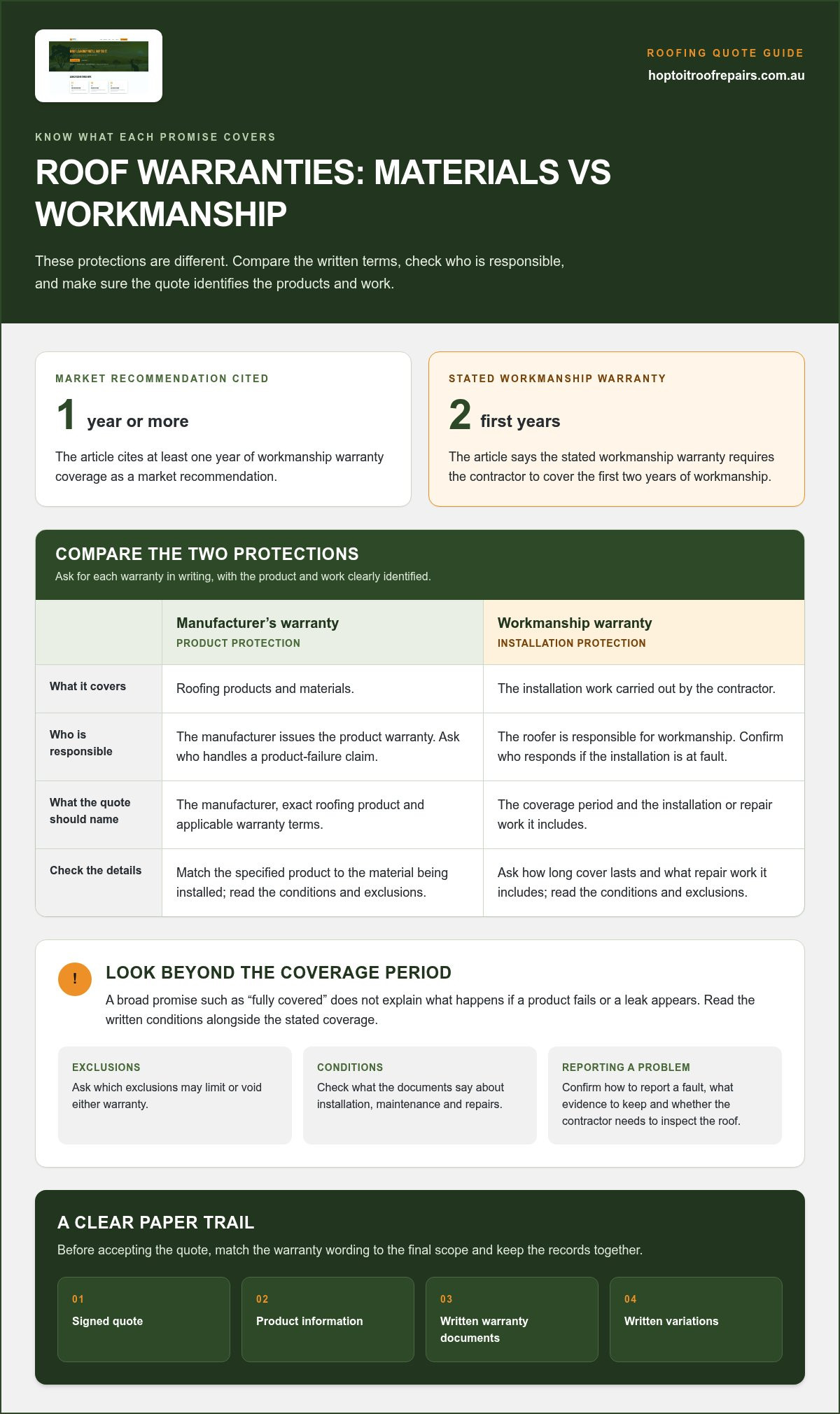
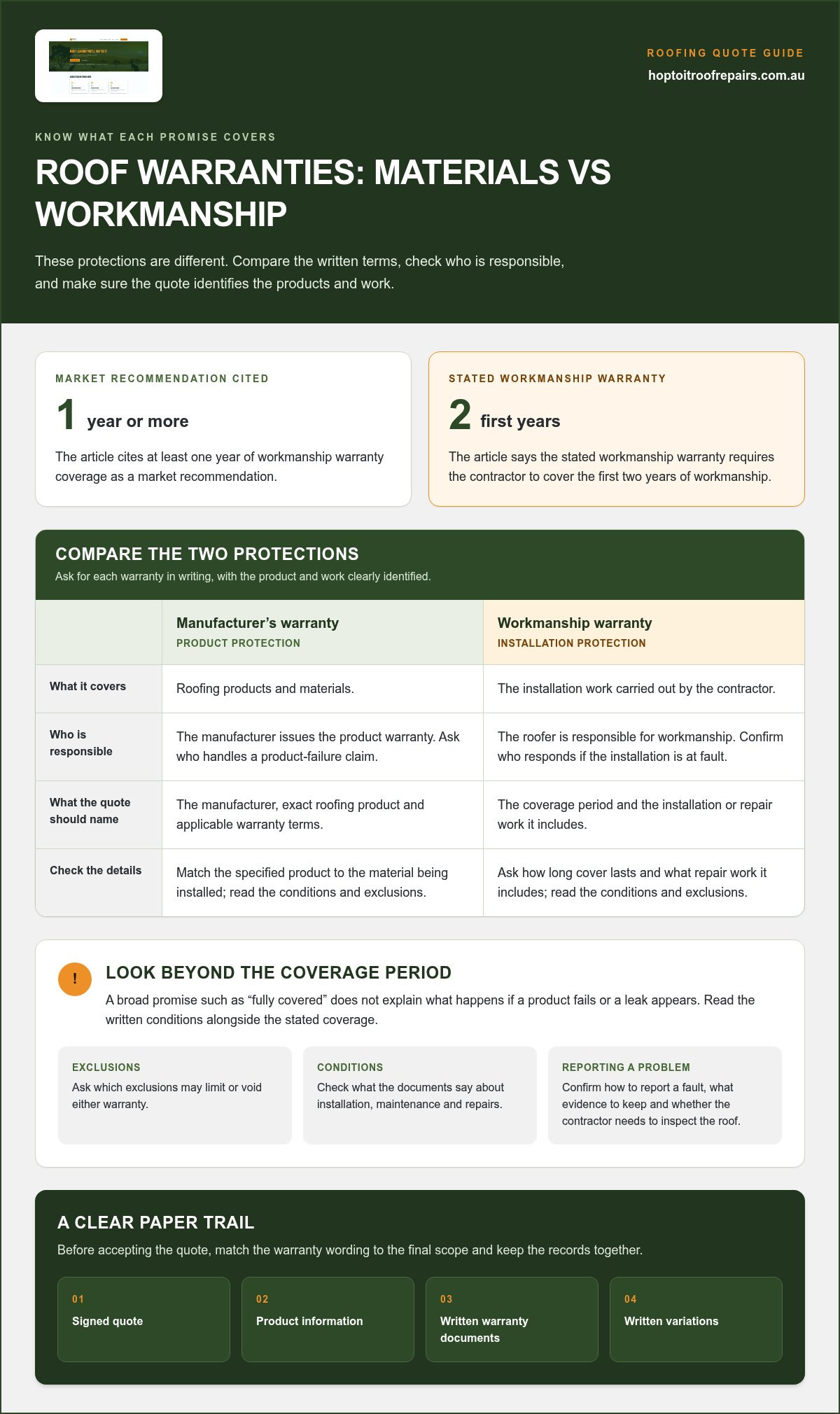
A roofing warranty can cover materials, workmanship or both, and these protections are different. The manufacturer’s warranty applies to roofing products, while the workmanship warranty covers installation. Ask for each warranty in writing, with the product and work clearly identified. A verbal assurance won’t explain what happens if a product fails or a leak appears after installation.
Ask how long workmanship cover lasts and what repair work it includes. A market recommendation is at least one year of workmanship warranty coverage. The stated workmanship warranty requires the contractor to cover the first two years of workmanship. Terms can differ, so compare the actual written offer rather than assuming every roofer provides the same cover.
For the manufacturer’s warranty, ask which exact roofing product it covers and who issues it. The quote should identify the manufacturer’s warranty and its terms. Check that the specified product matches the material being installed. If the quote says “metal roofing” or “roof tiles” without naming the product, ask for enough detail to connect the warranty to the materials supplied.
Read the conditions alongside the coverage period. Ask the contractor to identify exclusions and any conditions that could void either warranty. Check what the documents say about installation, maintenance, repairs and reporting a problem. Don’t rely on a broad statement such as “fully covered”. Ask for the relevant written clause and keep a copy with the quote and final paperwork.
- Materials: identify the manufacturer, product and applicable warranty terms.
- Workmanship: record the coverage period and what installation work it covers.
- Exclusions: note the conditions that may limit or void either warranty.
Ask who handles a claim if a roofing product fails and who responds if the installation is at fault. A clear answer separates the manufacturer’s product process from the roofer’s workmanship responsibility. Confirm how to report a fault, what evidence to keep and whether the contractor needs to inspect the roof. These details help you follow the right process instead of being passed between parties.
Before accepting the quote, match its warranty wording to the final scope. If the job includes replacement materials and related work, make sure the paperwork describes those parts accurately. Keep the signed quote, product information, warranty documents and written variations together. That record gives you a clear reference if you need to raise an issue later.
3. Contractor experience and local presence
Roofing experience should match the job, not just the contractor’s general trade background. Ask how often they work on your roof type and request an example involving a similar issue. Metal roof repairs, for instance, require familiarity with metal roofing details and common leak points. Ask what they found, how they approached the repair and how they checked the completed work.
Local knowledge matters because roof designs and weather conditions vary across Australia. Ask how the contractor’s experience in your area informs their assessment, material choices and work schedule. A local roofer may understand how regional weather affects roof performance and installation planning. Ask for nearby project examples that show relevant experience, rather than relying on a broad claim of local expertise.
Check the track record through project details, not just years in business. Ask who completed the work, whether the contractor managed the job directly and how they handled unexpected issues. If a previous project involved a leak, ask how its source was identified and what repair was completed. Specific answers help you judge whether the experience relates to your roof and the problem you need solved.
What should an Australian roofing quote include, and how can I compare quotes? It should itemise labour, materials, quantities, selected products and extra charges, then state whether removal, disposal, site protection, delivery, gutter or fascia work, permits and final clean-up are included. Compare matching scopes and exclusions, and check whether the written estimate identifies subcontracted work.
Ask how the contractor will supervise the work and keep you informed. Confirm who will be on site, who can approve changes and how you’ll receive updates if the schedule shifts. A responsible contractor should explain the work sequence plainly. For example, ask when materials will arrive, which roof sections are tackled first and how the crew will protect exposed areas if weather interrupts installation.
What safety measures should a roofing contractor use for working at heights in Australia? Ask for a site-specific safety plan explaining roof access, fall prevention, equipment, exclusion zones and how weather affects work at height. The contractor should describe how the crew will keep people below clear of the work area and pause when conditions make roof access unsafe.
Use these questions to connect experience with evidence. Match the contractor’s examples to your roof type, the quote’s scope and the proposed schedule. If a metal roof has recurring leaks, ask how their inspection will identify the source before repairs begin. Clear answers show whether their experience is relevant to your project, not simply familiar.
4. Contractor identity, licences and insurance
Start by confirming the legal business name of the contractor who will sign your agreement. Match that name across the written quote, contract, invoice and insurance evidence. If a different business will do the work, ask who is responsible for supervising it and resolving issues. Clear identities make it easier to know which business has agreed to the scope and terms.
Ask for a copy of the contractor’s licence and check the licensing requirements for your location. Licensing rules can differ across Australia, so confirm which requirements apply to the work and region. Don’t rely on a trading name or verbal assurance alone. Make sure the licence details relate to the business named in your paperwork.
Request current evidence of insurance, then check that the named insured business matches the contractor on your quote. Ask about public liability insurance and workers compensation arrangements where applicable. Also ask whether Contract Works insurance covers renovation claims for the project. These policies address different risks, so clarify what each covers and whether the proposed work falls within its scope.
Insurance documents should show the insurer, policyholder, type of cover and relevant dates. Ask the contractor to explain any exclusions that could affect your project. For example, if the quote includes roof repairs and gutter work, clarify whether both fall within the stated cover. Keep copies with the contract so you can refer to the same documents if questions arise during the job.
Clarify permits before accepting the quote. Ask whether permits or other project requirements apply, who will manage them and whether the quote includes those tasks. The written scope should mark permits, removal, disposal and site protection as included or excluded. This avoids confusion about responsibilities and makes it easier to compare quotes on the same basis.
What are common roofing contractor scams and warning signs in Australia? Warning signs include pressure to pay the full amount upfront, unclear business identities, and quotes that don’t describe the work or materials. Pause if insurance evidence, licence details or written terms don’t match the contracting business.
Before signing, confirm who can approve changes and how additional work will be documented. A sound process records the issue, revised scope and price, then gets your approval before work proceeds. Don’t treat an unexpected request for payment as approval. Keep messages, variations and receipts with the signed agreement.
Use a short document check before work starts: match the business name, review licence details, inspect insurance evidence and confirm permit responsibilities. If a contractor cannot explain a document plainly, ask for written clarification. Homeowners can then compare the paperwork itself, not just the confidence of the sales conversation.
5. Roofing materials, brands and product specifications
Don’t accept “metal roofing” or “roof tiles” as a complete materials description. Ask the roofer to name the proposed product, profile, finish and relevant specifications in the quote. These details let you compare like with like, rather than choosing based on a broad material label. Ask why the product suits your roof’s design and the repair or replacement work.
Roof pitch is a key compatibility check. If your home has a low-pitch roof area, ask for manufacturer information confirming the proposed material is suitable for that roof type. Suitability should be supported by product information, not just a verbal recommendation. Ask which document or specification confirms the match, and keep it with the written quote.
For homes across Brisbane, the Gold Coast, Redland Bay, Moreton Bay and Ipswich, check that the specified material suits the roof and its exposure. Ask what product features support the roofer’s recommendation and request the manufacturer’s product information. Compare the specified metal, finish or tile details across quotes. Different products suit different roof designs, so look for an explanation tied to your property.
Check that the quoted materials match the work described. If the scope includes replacing a damaged roof section, ask whether the new product will match the existing profile and finish. If it won’t, ask how the difference will affect the finished appearance and how the roofer will transition between materials. For tile work, confirm the type proposed and whether it fits the existing roof system.
Ask how the materials connect with other roof components. Flashings, valleys, ridges and roof penetrations all need to work with the selected roofing product. Request an explanation of how the specified materials will meet around features such as vents or skylights. If gutters or fascia work is included in the quote, check that those items are described separately rather than hidden within a general materials allowance.
Before agreeing, compare each quote using the same checklist: product name, profile, finish, quantity, roof-area suitability and included components. Ask the roofer to explain any differences plainly. A lower quote may describe a different product or leave out an item, so compare the written specifications before judging the total.
Keep the product information with your quote and final paperwork. If you need help assessing roof repair options, use the proposed materials and roof conditions as the starting point for a clear discussion.
Hop To It Roof Repairs: Roof Leak Detection
Hop To It Roof Repairs can help when a roof leak needs investigation or a metal or tile roof needs repair. Roof Leak Detection helps identify where water is entering, while repair work can address the affected roof area. For related drainage concerns, the team also handles Gutters & Downpipes.
For homeowners across Brisbane and the Gold Coast, the next step is a clear assessment of the roofing issue. Hop To It Roof Repairs provides fixed-price quotes and detailed written reports for every job, giving you documented information about the work. If you’ve found a leak or need a roof repair, contact Hop To It Roof Repairs to discuss the issue.
Make your next roofing decision with confidence
Use your questions to ask a roofing contractor as a practical decision tool, not just a checklist. Compare how each answer relates to your roof, the proposed work and the documents you’ll keep. If an explanation doesn’t make sense, ask for it in plain language before deciding. A clear understanding now makes it easier to take the right next step.
If you’re dealing with a roof leak or need repairs to a metal or tile roof, Hop To It Roof Repairs can help with Roof Leak Detection, Metal Roof Repairs and Tile Roof Repairs. Share what you’ve noticed and the information you’ve gathered so the issue can be discussed clearly.
Contact Hop To It Roof Repairs to talk through your roofing concern. You’re better placed to choose a solution when the problem and next steps are clear.
Frequently Asked Questions
What questions should I ask a roofing contractor before hiring them in Australia?
Ask who will do the work, how the scope will be documented and how you’ll receive updates if the plan changes. The most useful questions to ask a roofing contractor focus on your specific roof and proposed work, not general promises. In Brisbane, the Gold Coast, Redland Bay, Moreton Bay and Ipswich, ask whether the contractor’s examples reflect local roof types and weather conditions.
How can I check a roofing contractor's licence and qualifications in my Australian state or territory?
Ask for the contractor’s licence details and confirm the business name matches the quote and contract. Then check the relevant state or territory licensing body’s register or contact the appropriate local government office about requirements for your project. Check that the licence relates to the proposed work, such as roof plumbing. Keep a copy of the details with your written agreement.
What insurance should an Australian roofing contractor have, including public liability and workers compensation?
Ask for evidence of public liability insurance and workers compensation arrangements where applicable. Also ask whether Contract Works insurance covers renovation claims for the proposed work. Compare the policyholder’s name with the business named in your contract, and check the policy dates and relevant exclusions. If subcontractors will attend, clarify how their insurance arrangements apply to the project and who is accountable for the work.
What warranties and workmanship guarantees should I ask a roofing contractor about?
Get the manufacturer’s product warranty and the roofer’s workmanship warranty in writing, and check what each covers. Ask how to report a fault, who assesses it and what records you’ll need. The stated workmanship warranty requires the contractor to cover the first two years of workmanship, while market guidance recommends at least one year of cover. Read the specific terms and exclusions before signing.
How can I check a roofer's references, reviews, and past work in Australia?
Look for project examples that match your roof type and the work you need, then ask a reference about the finished result and follow-up. Check whether reviews describe specific work, such as tracing a leak or replacing damaged tiles, rather than relying only on star ratings. Photos can show visible details, but ask what work they document and whether the project scope resembles yours.
Does roof replacement in Australia require council approval or comply with the National Construction Code?
Approval requirements depend on the proposed work and local property controls, so ask which approvals apply before work begins. Have the quote identify permit-related tasks and who will manage them. Ask how the proposed work addresses applicable National Construction Code requirements, and request the relevant details in writing. This gives you a clear record of the project’s approval and compliance responsibilities.
What questions should I ask about roofing materials, ventilation, insulation, and energy efficiency?
Ask for the exact material and product specifications, plus manufacturer information confirming the product is suitable for your roof type and pitch. For a low-pitch area, get that compatibility evidence before agreeing. Ask how roof-space ventilation and insulation affect the proposed work and whether existing ventilation will be assessed. Request a plain-language explanation of how the selected materials and roof design relate to your home’s energy performance.