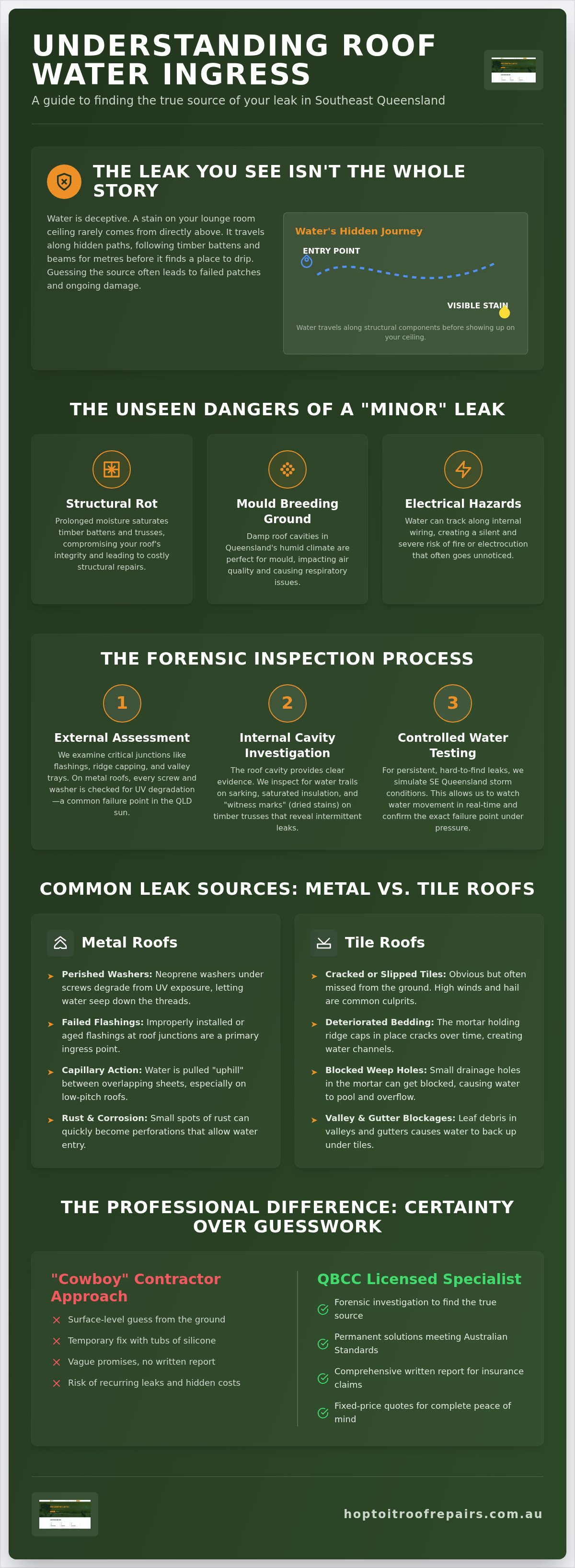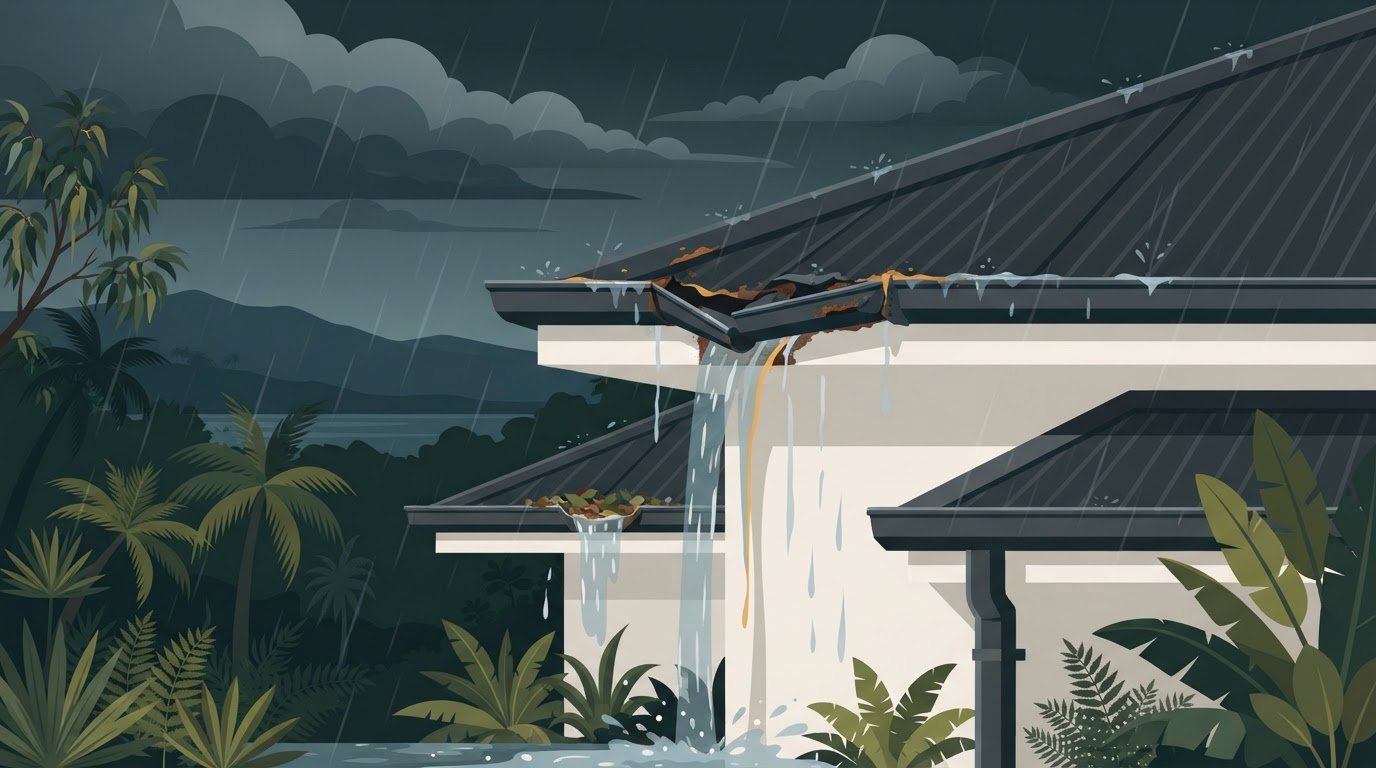
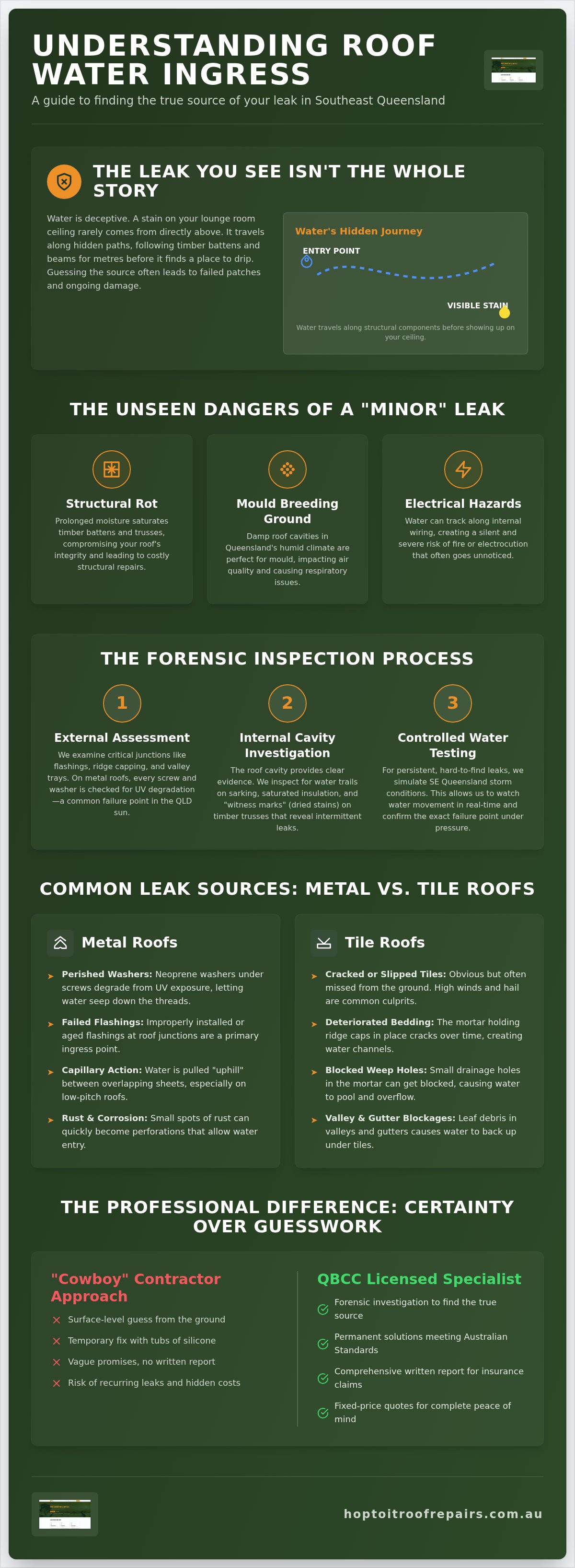
Why does a water stain in your lounge room so often have nothing to do with the roof tiles directly above it? Water is deceptive, often travelling metres along internal timber battens before it finally drips through your ceiling. Relying on a guess is a recipe for hidden structural rot and mould. Booking a professional roof water ingress inspection is the only way to stop the cycle of temporary patches and find the actual entry point. You need a specialist who understands how Southeast Queensland's intense storm cycles interact with your specific roof type.
It's stressful when "cowboy" contractors charge you for fixes that don't actually stop the leak. You want certainty, not another tub of silicone and a vague promise. This guide explains how a forensic investigation identifies the true source of your leak and provides a clear, fixed-price path to a permanent repair. We'll also detail what to expect in your written investigation report, ensuring you have the evidence required for insurance claims and the absolute peace of mind that your home is dry and secure.
Key Takeaways
- Understand how a professional roof water ingress inspection uses forensic tracking to locate the true entry point, even when it's metres away from the ceiling stain.
- Identify the unique vulnerabilities of metal and tile roofing systems caused by Southeast Queensland's extreme heat and heavy storm cycles.
- Learn why a comprehensive written report is your most powerful tool for securing insurance approvals and ensuring repair accountability.
- Recognise the importance of engaging a QBCC licensed specialist to guarantee that your repairs meet strict Australian standards and structural requirements.
- Shift from temporary patches to permanent solutions with fixed-price quotes that eliminate the risk of "cowboy" trade guesswork.
What is a Roof Water Ingress Inspection?
Water ingress is the unintended entry of water into a building envelope through the roofing system. It isn't just a nuisance; it's a structural threat. A professional roof water ingress inspection differs significantly from a "quick look" by a general handyman. While a casual observer might spot a cracked tile, a forensic investigation tracks the water’s path from the entry point to the exit point. Ground-based visual checks are largely useless for modern Southeast Queensland homes with complex pitches and hidden box gutters. You need a QBCC licensed specialist who understands how water behaves under pressure.
A specialist doesn't just look for holes. They examine the integrity of flashings, the condition of fasteners, and the effectiveness of your drainage system. They identify non-obvious entry points where water might be forced "uphill" by wind or pulled through gaps by capillary action. This level of detail is the only way to ensure a repair actually works the first time.
The Consequences of Ignoring Early Ingress Signs
Small ceiling stains are often the tip of the iceberg. By the time you see a mark on your plasterboard, the water has likely been saturating your roof cavity for weeks. This leads to timber rot in your structural battens and trusses, compromising the roof's integrity. In the humid climates of Brisbane and the Gold Coast, this moisture creates a breeding ground for mould. This impacts indoor air quality and can trigger respiratory issues. Perhaps most dangerously, water often tracks along internal electrical wiring or downpipes. This creates a silent fire or electrocution risk that most homeowners never consider until it's too late.
When to Organise a Professional Inspection
Timing is everything. You should organise a roof water ingress inspection immediately after any major SE QLD storm involving high wind speeds or hail. Don't wait for a visible drip to appear. Watch for subtle signs like bubbling paint on cornices, persistent damp smells, or unusual "ticking" sounds during heavy rain. If you're buying a property, an inspection is vital. It prevents you from inheriting a "renovator's delight" with thousands of dollars in hidden water damage. A professional report gives you the evidence needed to negotiate or walk away before you're locked into a structural nightmare.
The Forensic Process: How Specialists Track Water Ingress
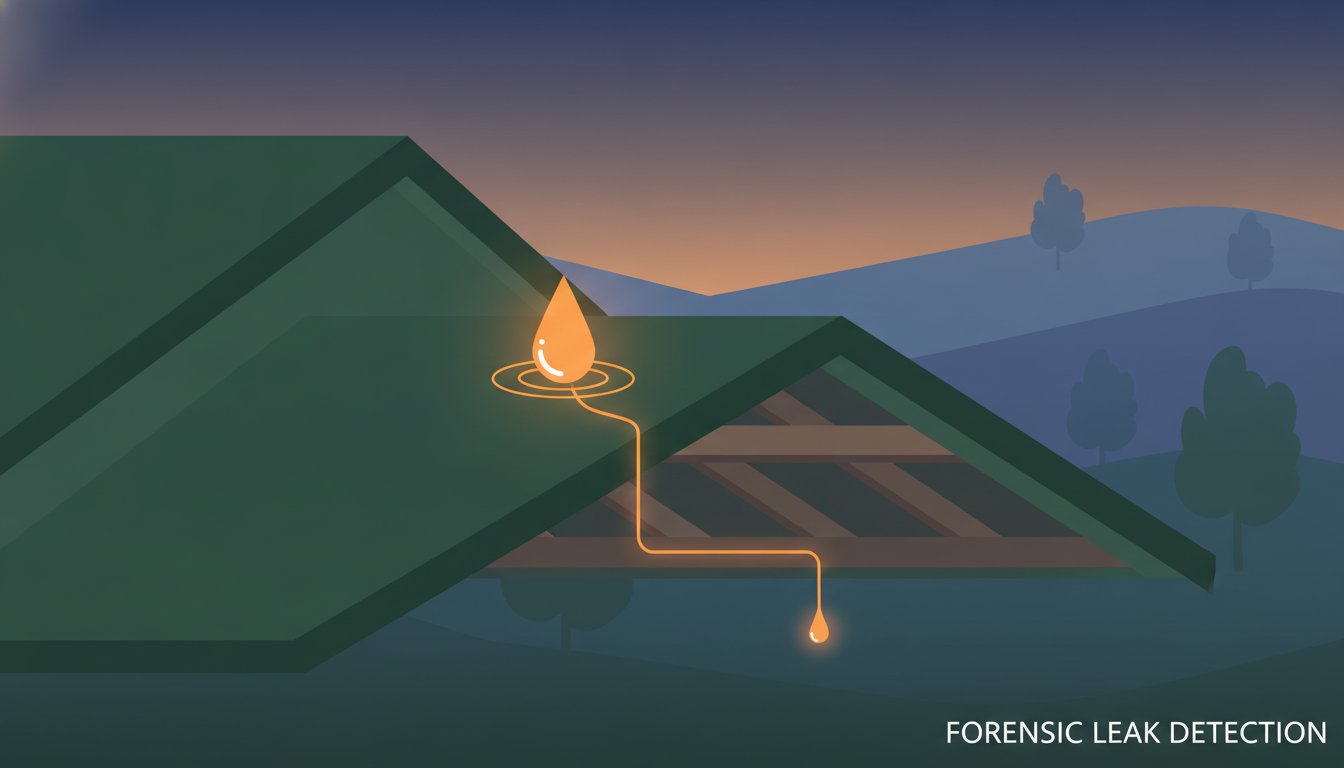
A leak is rarely a straight line. If you see a water stain in your hallway, the actual hole could be several metres away over your bedroom. Water follows the path of least resistance, often clinging to the underside of structural components. During a professional roof water ingress inspection, we look for these hidden paths. Surface tension allows water to "stick" to the bottom of horizontal roof battens, moving across the ceiling space until it hits an obstruction and drips. Capillary action is another culprit. It literally sucks water "uphill" into the tiny gaps where roof sheets or tiles overlap.
Our forensic process involves identifying visual evidence that a generalist might miss. We look for rust streaks on the underside of metal cladding and salt deposits on the back of roof tiles. These are clear indicators of long-term moisture. If the leak is stubborn, we use controlled water testing to simulate storm conditions. By recreating the pressure of a SE QLD storm, we can watch how the water moves in real-time, confirming exactly which joint or fastener is failing.
Internal Cavity Investigation
The roof cavity holds the most honest evidence. We inspect the underside of the sarking, the reflective foil insulation, for water trails or damp patches. Saturated insulation batts are a major red flag. When insulation gets wet, it loses its thermal properties and compresses. We also search for "witness marks." These are dried-out stains on timber trusses that indicate an intermittent leak. These often only occur when the wind blows from a specific direction, pushing water into gaps that stay dry during vertical rain.
External Component Assessment
On the outside, we examine the critical junctions. Flashings, valley trays, and ridge capping are the most common failure points. We ensure your installation aligns with QBCC standards for roof flashing to prevent future ingress. On metal roofs, we check every screw. The neoprene washers under roof screws are prone to UV degradation in the Queensland sun. Once they perish, water seeps down the thread directly into your ceiling. We also evaluate your guttering capacity. Many older homes have downpipes that simply cannot handle the volume of water produced during a modern SE QLD storm event. If you want to identify these weak points early, you can arrange a specialist inspection to secure your home's structural integrity.
Common Ingress Points: Metal vs. Tile Roofs
Metal and tile roofs react differently to the harsh Southeast Queensland climate. While metal roofs are known for their durability, they are highly susceptible to thermal expansion. Tiles, on the other hand, suffer from material degradation and structural shifting. A professional roof water ingress inspection must account for these material-specific behaviours to be effective. Inadequate flashing remains a major issue across both types, featuring prominently among the top ten defects identified by the QBCC. Understanding these vulnerabilities is the first step toward a permanent fix.
Metal Roof Vulnerabilities
Metal sheets, particularly Colorbond, expand and contract significantly as temperatures fluctuate. This constant movement places immense pressure on fixings and lap joints. Over time, roof screws can pull loose or the neoprene washers perish under intense UV exposure, creating a direct path for water. We often find inadequate "turn-ups" at the top of sheets or "turn-downs" at the gutters. These small metal lips are vital; without them, wind-driven rain blows back into your roof cavity. Skylights and penetration seals are also frequent culprits, as the sealant dries and cracks, eventually failing during heavy downpours.
Tile Roof Vulnerabilities
Tile roofs are prone to slow-release moisture ingress that can go unnoticed for months. Porous terracotta or concrete tiles eventually soak up water during prolonged rain, leading to dampness in the ceiling space. Broken or slipped tiles, often caused by heavy storm debris or inexperienced foot traffic, create obvious gaps for water. However, the ridge capping is where most problems start. If the mortar pointing has degraded or cracked, water blows underneath and bypasses the tiles entirely. Debris build-up in valley trays is another critical failure point. During a Brisbane "rain bomb," blocked valleys cause water to back-flow under the tiles and into the ceiling space, bypassing the usual drainage path.
Box gutters and valley trays act as the main arteries of your roof. In high-volume runoff events, any restriction in these areas leads to immediate ingress. A forensic inspection ensures these components are clear and correctly sized for the catchment area. We check for rusted valley trays and ensure the overflow systems are functional. If these high-capacity areas fail, the volume of water entering your home can cause catastrophic structural damage in minutes. Identifying these weak points before the next storm season is the only way to protect your property and your peace of mind.
Decoding the Roof Leak Investigation Report
A verbal "she'll be right" doesn't hold up when you're dealing with insurance companies or structural rot. A professional roof water ingress inspection must conclude with a comprehensive written report. This document acts as a forensic record of your roof's health. It bridges the gap between identifying a problem and executing a permanent fix. Without it, you're left with guesswork and the risk of "cowboy" tradies who fix symptoms rather than causes. You need a document that stands up to scrutiny.
Our reports translate complex trade terminology into plain English. You might see terms like "capillary break" or "thermal movement," but we explain exactly how these factors caused your specific leak. This transparency ensures you understand the "why" behind the "how much." It also provides the necessary data to justify a fixed-price repair quote. When every fault is documented with photographic evidence, there are no surprises or hidden costs during the repair phase.
Key Sections of a Hop To It Roof Repairs Inspection Report
Every report we produce follows a logical structure designed for clarity and accountability. We start with site observations, providing high-resolution photographic documentation of every identified fault. We don't just tell you a flashing is failing; we show you the evidence. Next, we provide a definitive "cause of failure" analysis. This is critical for distinguishing between sudden storm damage and gradual wear and tear. Finally, we outline a detailed scope of works. This is a step-by-step roadmap of the materials and methods required to return your roof to a watertight state.
Using Your Report for Insurance Claims
Insurance companies are notoriously strict about "maintenance issues." They'll often reject a claim if they suspect the ingress was caused by long-term neglect. A detailed report from a licensed roof plumber following a roof water ingress inspection is your best defence. It provides the professional evidence required to prove that a sudden event, like a Brisbane hailstorm, caused the damage. This documentation prevents insurers from suggesting a cheap "patch-up" job that will likely fail during the next wet season. Instead, it forces a focus on a compliant, long-term solution. If you've discovered a leak after a storm, request a detailed report to secure your insurance position and protect your home's value.
Why a QBCC Licensed Roof Plumber is Essential
In Queensland, there's a strict legal line between a general builder and a licensed roof plumber. While a builder understands general structures, only a specialist with a Certificate III in Plumbing is qualified to manage the complex hydraulics of a roofing system. A professional roof water ingress inspection conducted by a QBCC licensed expert ensures you're protected by statutory insurance and rigorous technical standards. This licensing isn't just a badge; it's your guarantee of accountability. For any work valued over $3,300, a QBCC license is a legal mandate. Choosing a licensed specialist means your repairs meet the National Construction Code, providing a level of safety that a generalist simply cannot offer.
Our approach focuses on removing the anxiety often associated with trade services. We prioritise transparency and immediate relief for the homeowner. Once the inspection is complete, we provide fixed-price quotes. This eliminates the risk of "bill shock" or hidden surprises once the work starts. Every repair we undertake comes with a workmanship warranty, giving you long-term confidence in the result. We don't believe in temporary patches that fail during the next heavy downpour. Instead, we provide evidence-based solutions that restore the structural integrity of your property.
The "Make-Safe" Service
High-stress situations often arise during active storm seasons when permanent repairs aren't immediately possible due to rain. In these cases, we provide an emergency temporary make-safe service. This involves immediate measures to stop water entering the building envelope, preventing further damage to your ceilings, insulation, and electrical systems. It's a vital step that protects your home while we wait for a suitable weather window. Once the conditions are safe, we move quickly from the temporary fix to the permanent, warranted repair outlined in your investigation report.
Our Service Areas: Brisbane to the Gold Coast
We provide specialised leak detection and repairs across Brisbane, the Gold Coast, Redland Bay, Moreton Bay, and Ipswich. Every region in Southeast Queensland presents unique challenges. Coastal homes face corrosive salt air that perishes neoprene washers, while western suburbs often deal with intense hailstorms and high wind loads. We understand these local nuances and how they impact specific roofing materials and designs. Our team is energetic, agile, and ready to solve your roofing problems with professional authority. Organise your professional roof water ingress inspection today.
Secure Your Home with Forensic Accuracy
Stop the cycle of temporary patches and hidden structural damage. A professional roof water ingress inspection is the only way to move from uncertainty to a permanent, warranted solution. You now understand that water tracking is a forensic process and that your detailed investigation report is a vital legal and financial asset for insurance and peace of mind. Don't let a small ceiling stain turn into a structural disaster or a rejected claim.
We remove the stress by providing QBCC licensed roof plumbers who deliver evidence, not guesses. Every inspection includes a detailed written report and the absolute clarity of fixed-price quote transparency. Whether you have a metal roof in Brisbane or a tiled home on the Gold Coast, our goal is to ensure your property remains watertight and secure. Take control of your home's maintenance before the next storm hits.
Book your expert roof leak detection and inspection report today and get the immediate relief that comes with specialist expertise. Your home is your biggest investment; protect it with a team that values your time and structural safety.
Frequently Asked Questions
How much does a roof water ingress inspection cost in Brisbane?
The cost of a roof water ingress inspection depends on the size of the roof and the complexity of the issues. While basic visual checks might be cheaper, a forensic investigation including internal cavity checks and photographic documentation requires more time. We provide clear pricing for our specialised services to ensure you aren't hit with hidden fees. This investment prevents thousands of dollars in future structural repairs and mould remediation.
Can I do my own roof leak inspection with a ladder?
You can check for obvious debris, but a DIY inspection is rarely sufficient for tracking complex leaks. Most ingress points aren't visible from a ladder. Professionals use forensic techniques to track water movement along battens and sarking. Climbing onto your roof also carries significant safety risks and could void your home insurance if you cause accidental damage. It's safer and more accurate to engage a licensed specialist for a proper assessment.
Will my home insurance cover a roof water ingress inspection?
Coverage depends on your specific policy and the cause of the leak. Most insurers cover damage caused by sudden storm events but exclude gradual wear and tear or maintenance issues. Providing a detailed report from a licensed roof plumber is often a prerequisite for an insurance claim. Our reports clearly state the "cause of failure," which helps your insurer determine if the ingress was the result of a covered event like hail.
How long does a professional roof inspection take?
A thorough roof water ingress inspection typically takes between one and two hours. This timeframe allows us to inspect the external roof surface, internal ceiling cavity, and all critical flashings. We don't rush the process because finding the true entry point requires patience and forensic tracking. Once the physical inspection is complete, we compile the photographic evidence and technical data into your written report for delivery.
What is water tracking and why is it so hard to find?
Water tracking occurs when rain enters at one point and travels along internal structures before dripping. Surface tension allows water to cling to timber trusses or wiring, often moving metres horizontally from the original hole. This is why a stain in your lounge doesn't mean the leak is directly above it. Identifying these paths requires a specialist who understands building hydraulics and the way water behaves under pressure.
Do you provide a quote for repairs after the inspection?
Yes, we provide a fixed-price quote for all recommended repairs following the inspection. This quote is based on the detailed scope of works outlined in your investigation report. We believe in total transparency, so you'll know the exact cost of the fix before any work begins. There are no hidden surprises or "estimates" that grow over time. You receive a clear path to a watertight home with guaranteed pricing.
Is a roof plumber different from a general plumber?
Yes, a roof plumber is a specialist licensed specifically for roofing and drainage systems. While general plumbers focus on internal pipes and sewerage, roof plumbers are experts in the building envelope and external water management. In Queensland, the QBCC requires specific qualifications for roof plumbing. Engaging a specialist ensures your flashings, gutters, and roof sheets are installed to strict Australian standards, protecting your home from structural water ingress.
What happens if you find more damage during the repair?
Our forensic inspection process is designed to identify all issues upfront to prevent surprises. If we discover hidden structural rot once materials are removed, we stop work and consult with you immediately. We provide a clear explanation and an updated fixed-price quote for the additional work. We never proceed with unauthorised repairs. Our goal is to ensure the final result is fully warranted and your home's integrity is restored correctly.