Roof plumbing certificates and compliance for property owners
21 November 2026 · 10 min read
A roof plumbing compliance certificate records the plumbing work it covers. It is not a blanket sign-off for every part of a roof. The certificate recognises that the recorded work complies with the required plumbing standards, codes and regulations. To understand what a roof plumbing certificate covers, start with the work listed, which may include gutters, downpipes, roof flashing and roof coverings.
If you’re arranging roof plumbing work, ask what documentation you’ll receive and what it confirms. Discuss the certificate before work begins so its scope and handover are clear, and establish whether local requirements make one necessary.
This guide explains which roof components and tasks may be covered, what compliance confirms, and when to ask about a certificate. It also explains what to look for in the documentation, so you can understand the work record and decide what to do next.
Key Takeaways
- Understand how roof drainage and external flashings fit into the documented scope of roof plumbing work.
- See how gutters, downpipes and cladding relate to the work recorded on a compliance certificate.
- Learn what installation, maintenance and repair skills involve, and how they affect the work completed.
- Know what a compliance certificate confirms and when it’s relevant to your roof plumbing project.
Roof drainage systems and external flashings
A roof plumbing certificate relates to the plumbing work recorded for a property. Across Australia, roof plumbing work includes installing, repairing, altering and maintaining guttering, downpipes, roof flashing and roof coverings. Together, these components guide rainwater from the roof surface into gutters and downpipes. The certificate’s scope depends on the work it documents.
External flashings help manage water at roof edges and joins. For example, a job might replace flashing where a roof covering meets another surface, while also repairing a connected gutter section. The certificate relates to the plumbing work completed, not automatically to every part of the roof or unrelated building work.
The roof material affects the type of work involved. A metal roof, for example, may have sheets and flashing at joins, while another roof has a different covering. The material alone does not explain the drainage work. The tasks performed on gutters, downpipes or flashing also shape the job’s scope.
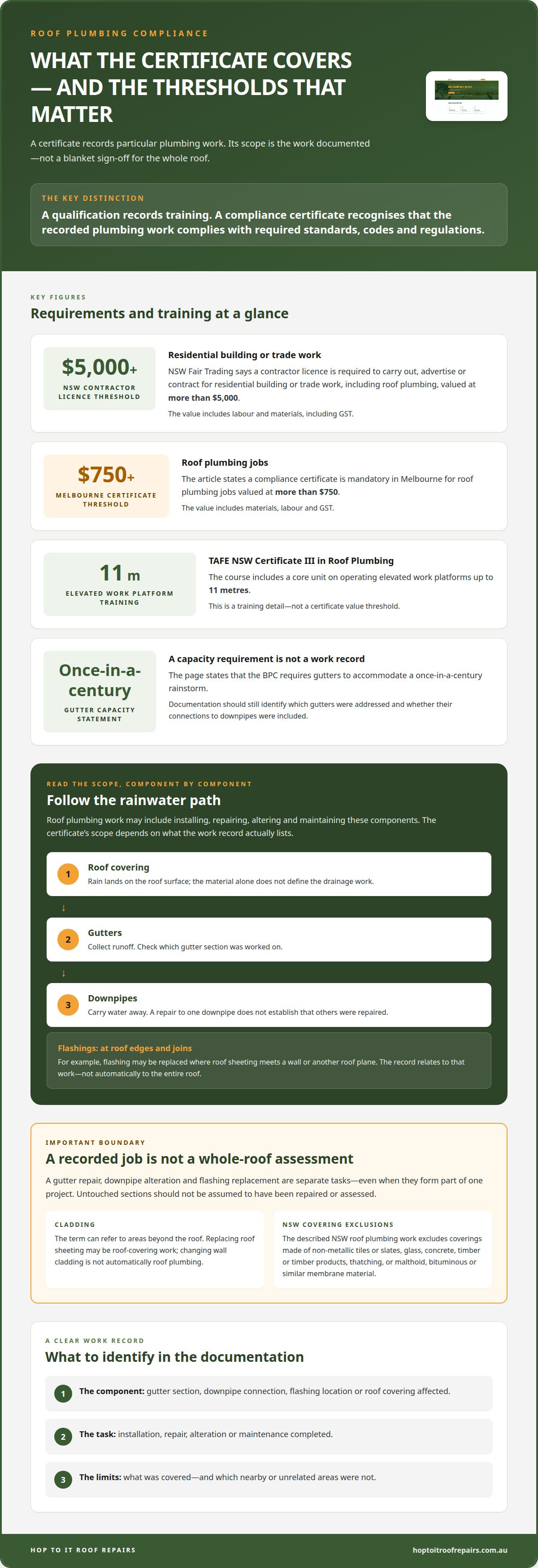
To understand the coverage, trace the path of water and identify each component worked on. A gutter repair, downpipe alteration and flashing replacement are separate tasks, even if they’re part of one project. The certificate should describe the work it records, not suggest that untouched sections were repaired or assessed.
A qualification and a compliance certificate have different purposes. A roof plumber’s qualification relates to training; a certificate recognises that particular plumbing work complies with required standards, codes and regulations. As a property owner, focus on which components were worked on and what the documentation records. A clear scope is especially useful when a job involves connected items such as roof coverings, external flashings and drainage components.
Roof plumbers install and maintain roof drainage systems on residential, commercial and industrial buildings. In NSW, roof plumbing work excludes work on coverings made of non-metallic tiles and slates, glass, concrete, timber and timber products, thatching, or malthoid, bituminous or similar membrane material.
NSW Fair Trading says a contractor licence is required to carry out, advertise or contract for residential building or trade work, including roof plumbing, valued at more than $5,000 in labour and materials including GST. In Melbourne, a compliance certificate is mandatory for roof plumbing jobs valued at more than $750, including materials, labour and GST.
In 2016, a Frankston roof plumber was contracted to replace roofs, gutters and flashings at three properties.
Gutters, downpipes, flashings and cladding
Gutters and downpipes are central to roof drainage: gutters collect runoff, and downpipes carry it away. Roof plumbing work in Australia includes installing, repairing, altering and maintaining these components, as well as roof flashing and roof coverings. In NSW, the defined work also includes fixing and renovating guttering, downpipes, flashing and roof coverings on buildings or structures.
Flashings manage water at joins and edges, including where roof sheeting meets a wall or another roof plane. If a job replaces flashing beside metal roof sheeting, the record relates to that work, not automatically to the entire roof. Similarly, repairing one downpipe does not establish that other drainage components were repaired. The documented scope should identify the components involved.
Cladding needs a careful distinction. Roof coverings fall within the broad description of roof plumbing work, but “cladding” can refer to materials or areas beyond the roof. Coverage therefore depends on the actual task and the part of the building involved. Replacing roof sheeting may be roof covering work, for example, while changing a wall’s external cladding is not automatically roof plumbing. The word “cladding” alone does not show that all related work falls within the certificate.
A practical way to read the scope is to trace the work item by item: identify the gutter section, any downpipe connection, the flashing location and the roof covering affected. This separates completed work from nearby areas left untouched. It also helps clarify whether a project covered drainage alone or included roof sheeting and flashing as well. For work involving gutters and downpipes, clear component-level documentation helps connect the repair to the relevant parts of the roof drainage system.
The page states that the BPC requires gutters to accommodate a once-in-a-century rainstorm. This capacity requirement is separate from evidence of completed work. Records should still identify which gutters were addressed and whether their connections to downpipes were included.
Installation, maintenance and repair skills
To obtain a roof plumbing certificate, define the work, have the roof plumbing completed, then receive documentation covering that work. The certificate recognises compliance with required plumbing standards, codes and regulations. It is different from a qualification, which records training.
Roof plumbing training develops practical skills for installing and maintaining roof drainage components. It covers fabricating and installing gutters, downpipes, skylights and rainwater systems, all of which require accurate measuring and fitting. For example, a downpipe must connect to the gutter system so rainwater follows its intended route.
Repair skills also apply to roof coverings and roof sheeting. A roof plumber identifies the affected area, carries out the relevant repair and keeps the work scope clear. Maintenance may involve addressing a damaged component before it affects connected parts, such as a gutter outlet or flashing. The certificate relates to the plumbing work completed, not the plumber’s career or every part of the roof.
Training includes workplace safety, manual handling, scaffolding and elevated work platforms. The TAFE NSW Certificate III in Roof Plumbing includes a core unit on operating elevated work platforms up to 11 metres. Height is a practical factor in roof work, alongside safe access and handling materials. These skills support installation and repair tasks on roofs, where roof sheeting and drainage components may need careful positioning.
In Australia, becoming a qualified roof plumber involves completing a four-year apprenticeship and obtaining a Certificate III in Roof Plumbing. In NSW, formal training with TAFE NSW and on-the-job training with an employer enable a graduate to register as a registered roof plumber with NSW Fair Trading. That qualification supports a career in roof plumbing, while a job certificate documents compliance for particular plumbing work. Keep the two documents distinct: one records the worker’s training, the other relates to work completed at a property.
It documents the roof plumbing work completed and recognises that it complies with required plumbing standards, codes and regulations.
What a roof plumbing compliance certificate confirms
A compliance certificate records that plumbing work meets the applicable requirements for the work and location. It relates to the documented job, not every roof component or unrelated building work.
Applicable standards and building codes
Standards and building codes depend on the Australian jurisdiction and the work performed. A certificate recognises compliance with required plumbing standards, codes and regulations, but one set of requirements does not apply to every roof job nationwide. Start by checking the certificate’s scope and the jurisdiction where the property is located.
Ask: what does a roof plumbing certificate cover? Look for a clear description of the work and the roof components involved. If a job includes replacing flashing and repairing a gutter, for example, the record should make that scope understandable. Don’t treat the certificate as proof that untouched areas, such as wall cladding or another roof section, were assessed.
Inspections and tests
A certificate confirms compliance; it does not, by itself, list a specific inspection or test. What is checked depends on the plumbing work and applicable requirements. A roof drainage repair involves different components from work on a roof covering, for instance. The documented scope helps show which completed work the certificate relates to.
Ask what a roof plumbing certificate covers before the work is signed off, then keep it with the job records. A work report or warranty serves a separate purpose and does not automatically become part of the certificate. Certification costs depend on the project’s scope, labour, materials and access; the quote gives the job-specific amount.
For a roof issue that needs assessment or repair, request roof leak detection to help identify the affected area and next steps.
Hop To It Roof Repairs
Hop To It Roof Repairs can help when a roof leak or damaged roof component needs attention before you can understand the work’s compliance record. Its roof leak detection and metal or tile roof repairs address common issues that may involve roof plumbing work.
For drainage concerns, Hop To It Roof Repairs’ gutters and downpipes service can help identify and repair affected components. Every job includes a detailed written report and a photo report of faults found, giving you a clear record to keep with the project documents. These reports are not compliance certificates, so keep each document’s purpose clear.
If you’re dealing with a leak, damaged roof or gutter problem, contact Hop To It Roof Repairs to discuss the work you need.
Make your next roof decision with clarity
Keep a clear history of roof work in your project records. When planning future maintenance or repairs, that history can help show what has already been done and where further attention may be needed.
If you’re still considering what a roof plumbing certificate covers, focus on the planned work and how its completion will be documented. A clear scope and written records help you understand the job without confusing a work report with a compliance certificate.
Hop To It Roof Repairs offers roof leak detection, metal roof repairs and tile roof repairs. If a roof issue needs attention, contact Hop To It Roof Repairs to discuss the work. A clear next step can make managing the roof feel more straightforward.
Frequently Asked Questions
When should I ask for a compliance certificate?
Ask about the certificate while agreeing on the work, then request it at handover if it applies to your job. Requirements depend on the work and the rules for the property’s location, so timing can vary. For a roof repair, clarify which components the documentation will cover. Keep the certificate with your job records for future maintenance.
Is a roof plumbing certificate legally required for new roofs or repairs in Australia?
There isn’t one Australia-wide rule requiring a certificate for every new roof or repair. Requirements depend on the jurisdiction and plumbing work involved. A project that includes roof plumbing may have different documentation requirements from one that does not. Before work begins, establish whether a certificate applies to the planned scope, then keep the completed documentation with your property records.
What documents and warranties come with a roof plumbing certificate?
The certificate records completed roof plumbing work and confirms compliance with required standards, codes and regulations. Work reports and warranties are separate documents, not automatically part of the certificate.