Expert Roof Drainage Solutions Brisbane: A Homeowner’s Guide to Storm-Ready Systems
2 September 2026 · 17 min read
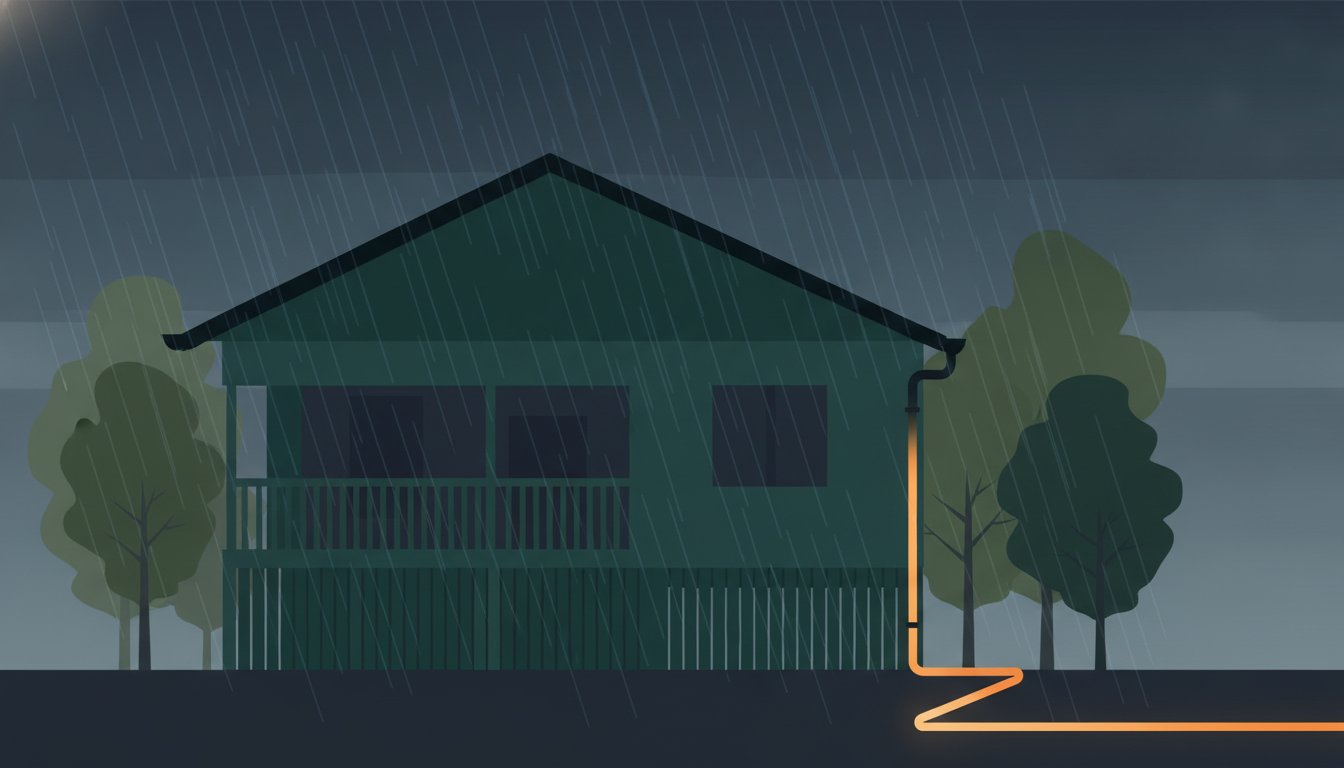
You're sitting in your living room when the first heavy drops of a Brisbane summer storm hit. Instead of enjoying the cool change, you're watching the eaves, waiting for the inevitable waterfall to spill over your gutters and the first damp patches to appear on your ceiling. It's a stressful way to live, but finding the right roof drainage solutions Brisbane properties actually need doesn't have to be complicated. You shouldn't have to dread the weather forecast or worry about structural water damage every time a storm cell crosses the coast.
We understand that standard guttering often fails during a true Queensland deluge. This guide shows you how to secure your property with professional strategies that handle high-volume rainfall. You'll learn how to move from storm anxiety to total confidence in your home's external defences. We'll break down the technical requirements of the NCC 2022 standards, explain how to identify specific points of failure in your current system, and outline the exact steps to implement a high-capacity drainage strategy that keeps your interiors bone dry and your foundations protected.
Key Takeaways
- Master the "Brisbane Storm Factor" to understand why subtropical rainfall requires higher-capacity systems than standard residential designs.
- Identify the essential components of robust roof drainage solutions Brisbane properties need, including the strategic use of rain heads and sumps.
- Recognise early warning signs of system failure, such as "tiger stripes" on guttering or damp patches appearing on your eaves.
- Compare how water behaves on metal versus tile roofs to address material-specific issues like water tracking and overflow.
- Learn the value of obtaining a detailed written report and a fixed-price quote to ensure transparency and long-term protection.
Understanding Roof Drainage in Brisbane’s Subtropical Climate
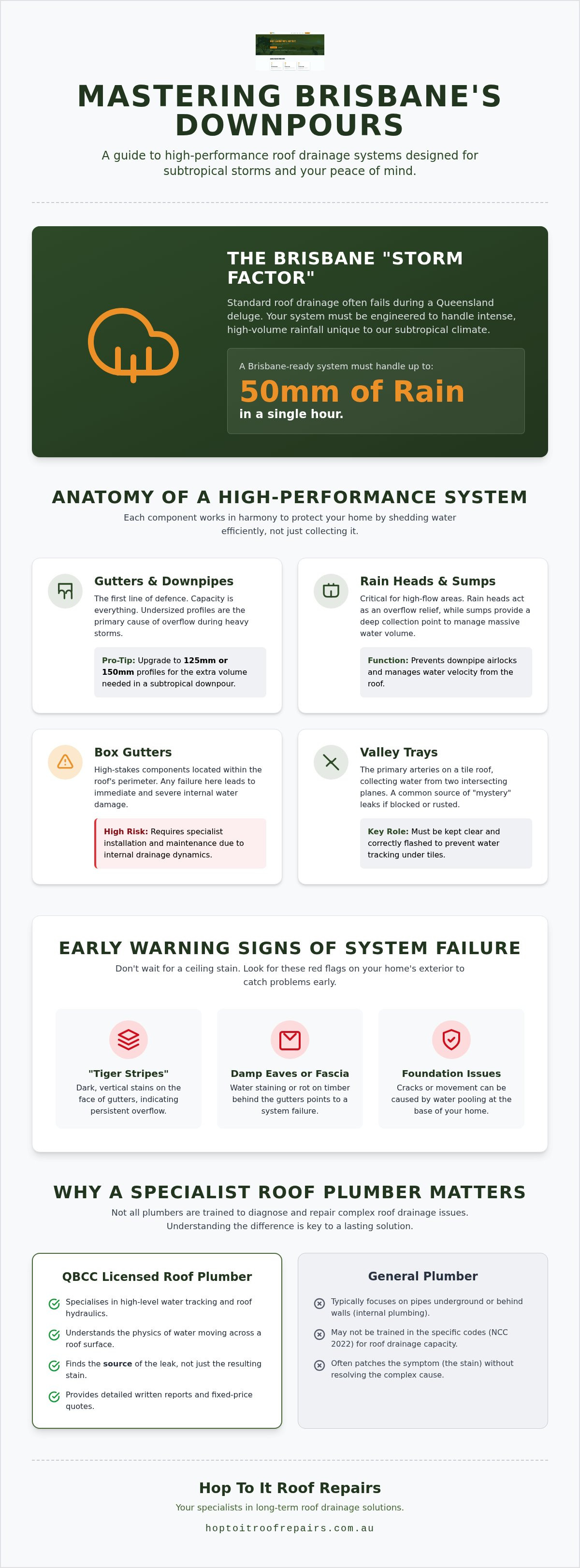
Roof drainage is the critical path water takes from the ridge to the stormwater pipes. It isn't just a collection of parts; it's an integrated system of components designed to shed water safely away from your home's structure. In Brisbane, we must account for the "Storm Factor". This means your system must be capable of handling up to 50mm of rain in a single hour. Standard designs often fail this test because they weren't built for subtropical intensity. There's a vital difference between "shedding" water and "collecting" it. A high-performance roof sheds water immediately. If your roof is collecting water in pools or slow-moving gutters, you have a drainage failure waiting to happen. For a detailed look at these components, you can consult a comprehensive guide to rain gutters to see how different materials and designs interact.
The Impact of Heavy Rain on Local Brisbane Homes
Storm season in coastal areas like Moreton Bay and Redland Bay puts immense pressure on residential structures. Many classic Queenslander roofs were designed for a different era of weather patterns. They often struggle with the sheer volume and velocity of modern, high-intensity downpours. When your system fails, the water doesn't just disappear. It overflows into eaves, tracks down internal wall cavities, and eventually settles in your foundations. This leads to foundation movement and persistent internal mould growth that can be difficult to eradicate. Implementing the right roof drainage solutions Brisbane families can rely on is the only way to prevent these costly structural issues before the next storm cell hits.
Why General Plumbing Isn’t Always Roof Plumbing
Don't assume any plumber can fix a complex roof leak. A QBCC licensed roof plumber is a specialist with specific training in high-level water tracking and roof hydraulics. General plumbers typically focus on pipes under the ground or behind the walls. We focus on the complex physics of water moving across a roof surface at height. This specialised knowledge is crucial because water often enters at one point and appears as a stain metres away. We find the source of the leak, not just the stain. We provide detailed written reports and fixed-price quotes to remove the guesswork. This ensures you aren't just patching a symptom but fixing the actual cause with a professional workmanship warranty.
The Anatomy of a High-Performance Roof Drainage System
High-performance roof drainage isn't just about sticking a pipe on a wall. It's a precise engineering feat involving gutters, downpipes, valleys, and flashings. Every component must work in harmony to meet the standards set by the National Construction Code. One of the most overlooked factors is the "fall" or gradient. If your gutters don't have a consistent slope toward the downpipe, water pools. This leads to accelerated corrosion and debris build-up. In high-flow areas, we use rain heads and sumps. Rain heads act as an overflow relief and prevent airlocks in the downpipes, while sumps provide a deep collection point to manage the massive volume of a Brisbane storm.
Gutters and Downpipes: The First Line of Defence
Capacity is everything. Your downpipes must be sized correctly based on the total catchment area of your roof. In Brisbane, we often recommend upgrading to 125mm or 150mm gutter profiles. These larger sizes provide the extra volume needed when a subtropical cell dumps weeks of rain in minutes. If your current system is struggling, check out our guide on gutter repairs Brisbane to understand how maintenance keeps these defences strong. Don't wait for the first overflow to realise your pipes are undersized. Small downpipes on a large roof are a recipe for disaster during the summer months.
Specialised Components: Box Gutters and Valley Trays
Box gutters are the high-stakes components of your roof. Because they sit within the roof's perimeter, any failure results in immediate internal water damage. This is why box gutter repairs Brisbane require a specialist roof plumber who understands internal drainage dynamics. Similarly, valley trays act as the primary arterial paths for tile roofs. They collect water from two intersecting roof planes and funnel it into the gutter. If these trays are rusted or blocked, water tracks under the tiles and onto your ceiling. This is where most "mystery" leaks begin. We ensure these trays are clear and correctly flashed to handle peak flow.
Effective roof drainage solutions Brisbane homeowners invest in are about long-term reliability and structural protection. If you're unsure about your system's health, book a professional roof inspection to identify potential weak points before the storm season peaks. Getting it right now saves a massive headache when the clouds turn grey.
Comparing Drainage Solutions: Tile vs. Metal Roofs
Water behaves differently depending on the surface it hits. On a smooth Colorbond roof, rainfall gains velocity quickly because there is very little friction. Metal roofs use long, continuous sheets that minimise joints, which is a massive advantage for drainage speed. In contrast, concrete or terracotta tiles are porous and textured. They don't just shed water; they manage it through a series of overlaps. Choosing the right roof drainage solutions Brisbane properties require starts with understanding these material-specific physics. While metal is about speed, tile is about precision management. If your drainage isn't calibrated for your specific roof type, you'll face issues like water tracking, where moisture "climbs" or seeps into areas it shouldn't be.
Drainage Challenges for Tile Roofs
The primary arterial paths for a tile roof are the valley trays. Because tiles are individual units, debris like leaf litter and silt often collects in these valleys. When a valley blocks, water backs up and forces its way under the tiles. This is where your sarking, the silver foil layer under your tiles, acts as a secondary drainage system. However, sarking isn't a permanent fix for a leak. If it's brittle or torn, that water lands straight on your ceiling. We also pay close attention to the "weep holes" in your ridge capping. These small gaps are designed to let moisture escape from the bedding. If a handyman has mistakenly blocked these with mortar, your roof can't breathe, leading to trapped moisture and eventual rot in the timber battening.
Drainage Solutions for Metal and Colorbond Roofs
Metal roofs are exceptionally durable, but they rely heavily on correct installation details to stay dry. At the top and bottom of every sheet, we perform "turn-ups" and "turn-downs". A turn-up involves bending the pans of the metal sheet upward at the ridge to prevent wind-driven rain from blowing over the top into your roof cavity. Conversely, turn-downs at the gutter line ensure water breaks its surface tension and falls cleanly into the gutter rather than tracking back along the underside of the sheet. We also frequently see drainage compromised by rusted screws. When the neoprene washer on a roof screw perishes, it creates a direct entry point for water. This is why we use custom flashings to bridge complex junctions where standard profiles won't provide a watertight seal.
The repair needs for these two systems are distinct. Tile roofs often require attention to cracked pointing or blocked weep holes, while metal roofs need verification of fixings and flashing integrity. Our specialist team identifies these nuances during every inspection. We ensure your specific material is working with the weather, not against it, giving you a storm-ready home that handles the heaviest Brisbane downpours without a drop entering your living space.
Signs Your Roof Drainage Is Failing (And What to Do)
You don't need to be a plumber to spot a failing system. Look for "Tiger Stripes". These are the dark soot or dirt lines running down the front face of your gutters. They are a definitive sign that your gutters are regularly overflowing. If water is spilling over the front, it's almost certainly spilling over the back into your eaves. Check your "soffit" or eaves lining for water rings, bubbling paint, or grey discolouration. Another red flag is "ponding". If you see standing water in your gutters 48 hours after the rain has stopped, your system has an incorrect fall or a significant blockage. Finally, observe your downpipes during the next heavy downpour. Any spraying or leaking from joins and elbows indicates a high-pressure blockage that needs immediate attention.
The Danger of Blocked Gutters and Internal Leaks
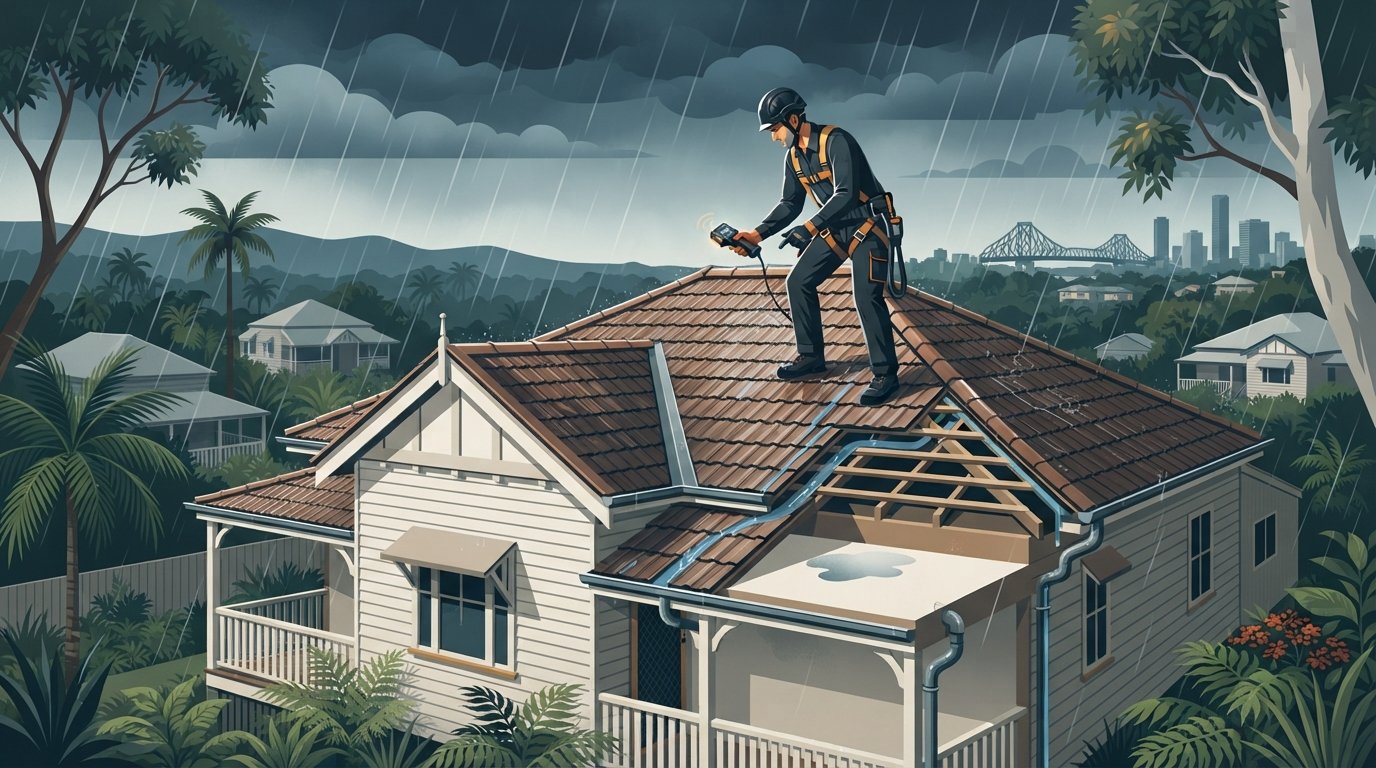
When debris accumulates, blocked gutters cause roof leaks by forcing water backward into your roof cavity. This is a common issue for Brisbane homes with lower roof pitches. Once water enters the roof, it often engages in "water tracking". This phenomenon occurs when water enters at the gutter line but travels along internal rafters or ceiling battens, eventually appearing as a stain in the middle of a room. This makes finding the source nearly impossible without professional gear. For complex or hidden entries, roof leak detection Brisbane specialists are required to pinpoint the exact entry point rather than just treating the symptom.
Proactive Maintenance for Brisbane Homeowners
Implementing effective roof drainage solutions Brisbane families can rely on starts with a 6-monthly maintenance routine. Don't wait for the storm clouds to gather before checking your system. Use this simple checklist to keep your home storm-ready:
- Clear Valleys: Remove all leaf litter and silt from valley trays to prevent water backing up under tiles or metal sheets.
- Check Seals: Inspect the silicone seals on gutter end-caps and downpipe pops for cracks or perishing.
- Test Downpipes: Flush your downpipes with a high-pressure hose to ensure they are clear all the way to the stormwater connection.
Be wary of "gutter guards". While they stop large leaves, they often hide a build-up of fine silt and sludge that can completely block your drainage path. If a major storm hits and you suspect damage, a professional "make-safe" service is essential to protect your interiors while permanent repairs are organised. If you've noticed eaves stains or overflowing gutters, it's time to act. Book a comprehensive roof inspection with Hop To It Roof Repairs today to secure a fixed-price quote and total peace of mind for the coming storm season.
Expert Roof Plumbing: Why Professional Solutions Matter
A general handyman might be able to clear a gutter, but they rarely understand the complex hydraulics required for high-capacity roof drainage solutions Brisbane homes need. Professional roof plumbing is about more than just clearing debris. It involves a deep understanding of the National Construction Code and the specific physics of water flow at height. When you hire a QBCC licensed specialist, you aren't just paying for a repair. You're investing in a correctly engineered system that protects your home's structural integrity for years, not just until the next storm.
One of the biggest hurdles for homeowners is "tradie anxiety". This usually stems from vague quotes and uncertain outcomes. We eliminate this by providing detailed written reports and fixed-price quotes before any work begins. Our reports include photographic evidence of the issues we find, ensuring you have a clear record for insurance purposes or future maintenance. We focus on finding the root cause of the problem. This ensures we fix the leak at its source rather than just patching a visible stain on your ceiling.
The Hop To It Process: From Detection to Repair
Our method is built on efficiency and accountability. We follow a structured three-step journey to resolve your drainage issues:
- Step 1: Precision leak detection. We use specialised techniques to trace water ingress back to its origin, identifying the exact point of failure.
- Step 2: Transparent reporting. You receive a comprehensive document with photos and clear, jargon-free recommendations so you understand exactly what needs fixing.
- Step 3: Fixed-price execution. We perform the repairs to professional standards, backed by a workmanship warranty for your total peace of mind.
Securing Your Home for the Next Brisbane Storm
Don't wait for a subtropical downpour to test your roof's limits. Proactive maintenance during the dry months is the most effective way to avoid the stress of an emergency situation. While we provide scheduled repairs across Brisbane, our service areas also extend to the Gold Coast, Logan, and Ipswich. We pride ourselves on being the specialised partner you can trust to get the job done right the first time without unnecessary delays.
Take control of your home's protection before the summer storm season peaks. Contact Hop To It Roof Repairs today to book your professional roof drainage assessment and secure your fixed-price quote. Getting your system ready now is the best way to ensure a dry, safe home when the heavy rain arrives.
Secure Your Home Before the Next Storm
Brisbane's subtropical climate doesn't give second chances to inadequate guttering. We've explored how high-capacity components like sumps and rain heads are essential for managing local rainfall intensities. You now know how to spot the early warning signs of failure, from "tiger stripes" to internal water tracking. Implementing the right roof drainage solutions Brisbane properties require is the only way to protect your foundations and your family's comfort during the summer storm season. Don't let a small leak turn into a structural disaster.
Our team of QBCC Licensed Specialists is ready to help. We provide detailed written reports with every assessment, ensuring you have total transparency and evidence for your records. Serving homeowners from Brisbane to the Gold Coast, we offer the expert precision needed to keep your home dry and secure. Take the guesswork out of maintenance and eliminate tradie anxiety with our transparent process. Get a Fixed-Price Roof Drainage Quote from Hop To It Roof Repairs today. You'll feel much better when the next storm cell crosses the coast knowing your roof is ready for whatever the weather brings.
Frequently Asked Questions
What are the best roof drainage solutions for heavy Brisbane rain?
High-capacity systems are the most effective roof drainage solutions Brisbane homeowners can install to manage subtropical rain. These systems include larger 125mm or 150mm gutter profiles, oversized downpipes, and the addition of rain heads or sumps. Rain heads prevent airlocks in the downpipes, allowing water to exit the roof much faster during a deluge. We design these systems to exceed standard building requirements, ensuring they handle the 50mm-per-hour storm intensities common in South East Queensland.
How much does it cost to fix roof drainage issues in Brisbane?
Fixing roof drainage issues varies in cost depending on the complexity of your roof and the specific components required. We don't provide generic estimates because every Brisbane home has a unique catchment area and drainage path. Instead, we offer fixed-price quotes after a thorough inspection. This transparency ensures you know the total cost upfront without worrying about hidden extras. Every quote comes with a detailed written report explaining the necessary repairs for your metal or tile roof.
Why do my gutters overflow even when they are not blocked?
Gutters often overflow during heavy rain if they are undersized or have an incorrect fall, even if they're perfectly clean. If the gradient isn't steep enough toward the downpipe, water pools and spills over the front edge. Additionally, if your downpipes don't have enough capacity to drain the volume of water hitting your roof, the system backs up. Upgrading to larger downpipes or adding extra drainage points often solves this issue without needing to replace the entire gutter system.
Is a box gutter repair different from standard gutter repairs?
Box gutter repairs are significantly more complex than standard gutter repairs because they sit within the building's perimeter. If a standard gutter fails, water spills outside; if a box gutter fails, water enters your internal ceiling and wall cavities immediately. These systems require precise engineering and high-level flashing to remain watertight. Because they carry a higher risk of structural damage, they must be handled by a specialist who understands internal drainage dynamics and high-flow requirements.
Do I need a specialised roof plumber or a general plumber for drainage?
You should always choose a QBCC licensed roof plumber for any drainage issues above the ground. While general plumbers are experts in sewers and internal pipes, they often lack the specialised training required for high-level water tracking and roof hydraulics. We focus specifically on how water moves across metal and tile surfaces. Our expertise ensures we find the actual source of a leak, which is often metres away from where the stain appears on your ceiling.
Can poor roof drainage cause structural damage to my home?
Poor drainage is a leading cause of long-term structural damage for Brisbane properties. When water overflows into your eaves or tracks down internal walls, it leads to timber rot and persistent mould growth. More seriously, consistent water pooling around your home's perimeter can cause foundation movement and cracking. Investing in a professional drainage assessment protects your home's value and prevents these expensive structural repairs. It's about keeping your foundations dry and your interiors safe.
How often should I have my roof drainage system inspected?
We recommend having your roof drainage system inspected at least every six months. The best times are just before the summer storm season begins and again once it concludes. Regular checks allow us to clear silt from valley trays, verify the integrity of your seals, and ensure your downpipes are free-flowing. This proactive approach identifies minor issues like rusted screws or cracked tile pointing before they turn into major internal leaks during a downpour.
What is a "make-safe" service and when do I need one?
A make-safe service is a temporary repair designed to secure your property immediately after damage occurs. It prevents further water ingress while you organise permanent repairs. You might need one after a severe storm or if a major leak is threatening your home's interior. While we don't offer 24/7 emergency call-outs, we provide scheduled make-safe services across Brisbane and the Gold Coast to protect your home and provide immediate relief from storm-related stress.