Water Tracking Roof Leak: Why the Ceiling Stain May Not Mark the Entry Point
12 October 2026 · 16 min read

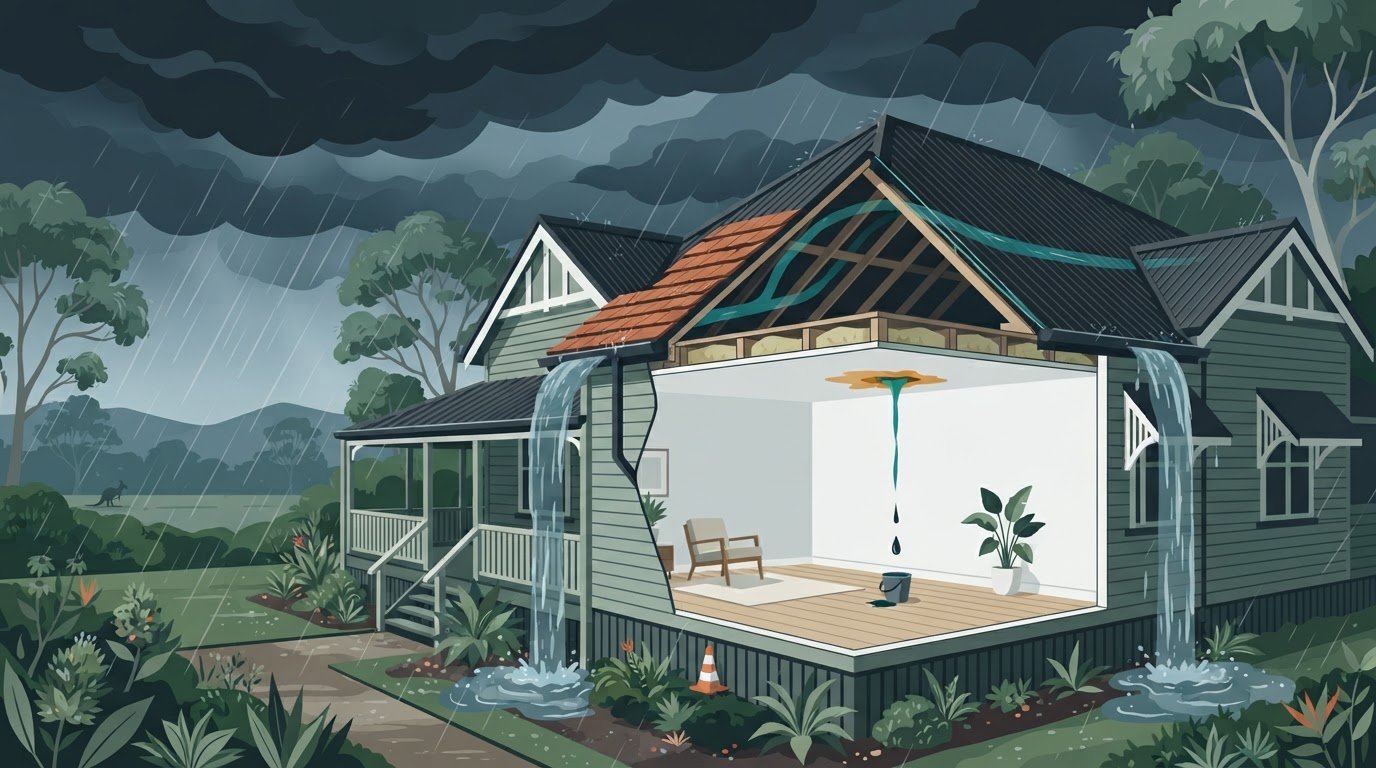
What if the ceiling stain is nowhere near the roof leak? With a water tracking roof leak, rainwater can run along roof framing, battens or sarking before it finds a place to drip indoors. The mark shows where water appeared, not necessarily where it entered, so the nearest roof feature may not be the source.
It’s understandable to worry that moisture is spreading above the ceiling, especially when a stain grows or returns after rain. Don’t climb onto the roof to investigate. Instead, note when the leak appears, whether it follows particular weather conditions and how the stain changes. Photos taken from a safe indoor position can preserve useful clues before conditions change.
This guide explains how water can travel through a roof space, what you can safely observe and when professional leak detection is the next step. For homes across Brisbane, the Gold Coast, Redland Bay, Moreton Bay and Ipswich, Hop To It Roof Repairs investigates roof leaks, documents the findings and provides a fixed-price quote for repair work. You’ll know what the clues mean and how to move towards a clear repair scope.
Key Takeaways
- A ceiling stain shows where water became visible, not necessarily where it entered the roof.
- In a water tracking roof leak, moisture may follow framing or other surfaces before dripping indoors.
- Record rainfall, timing and changes to the stain, and take photos from safe indoor positions.
- Nearby roof features and stain patterns can offer clues, but they don’t confirm the leak source on their own.
- Professional leak detection can connect indoor evidence with an investigation of metal or tile roofing and document the findings.
Water tracking from a roof leak: why the stain may be elsewhere
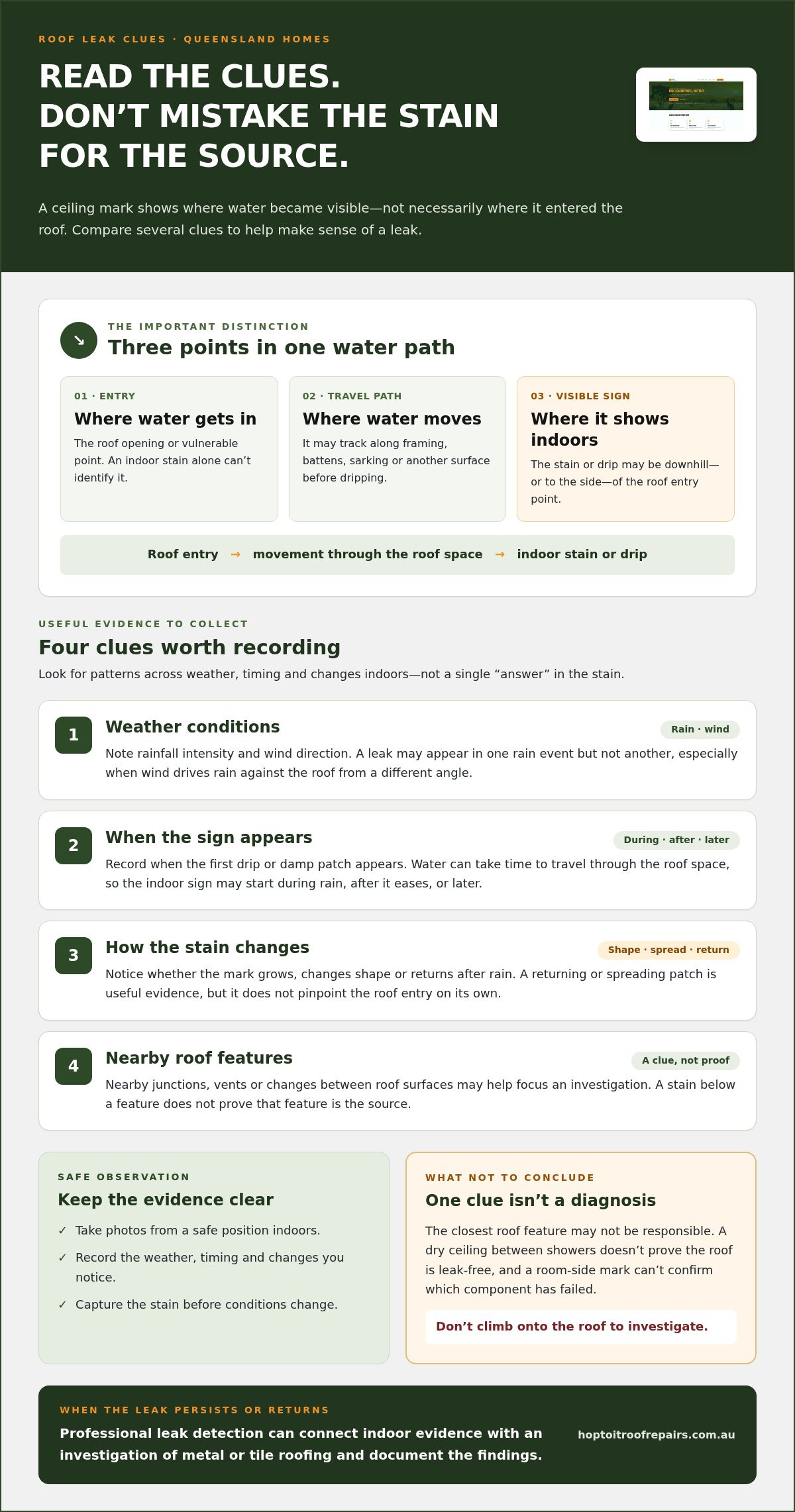
A ceiling mark can feel like a map to the problem, but it isn’t. Water tracking is the movement of rainwater from the point where it gets through the roof to a different place where it becomes visible indoors. Along the way, it may follow the roof’s slope, framing or other surfaces before gravity pulls it down.
The roof entry point is where water gets in; the travel path is the route it takes inside the roof space; the visible stain is where it finally shows up. These points can be separated by distance, so the nearest roof feature above a stain may not be responsible. A roof is made up of connected surfaces and components, and water can move across or along them before reaching a ceiling.
What a ceiling stain can, and cannot, tell you
A stain, damp patch or drip is useful evidence, but it needs context. Its position and shape can show where moisture is appearing and whether the affected area is changing. However, the mark may be downhill from the entry point, or water may travel sideways along a surface before dripping.
An indoor mark alone can’t confirm which roof component has failed. For example, a stain below a roof junction doesn’t prove that the junction is the source. Without tracing the water path, naming a cause from the room below is guesswork.
Why Queensland weather can make leak clues change
In Brisbane and on the Gold Coast, a leak may appear during one rain event but not another. Rainfall intensity can affect how much water reaches a vulnerable area, while wind direction can drive rain against roof surfaces from a different angle. A leak may therefore show up only under particular conditions.
Timing matters. A drip might start during heavy rain, appear after the rain eases or become noticeable later as water moves through the roof space. Record the weather and when the first indoor sign appeared. That detail helps make sense of changing clues without treating one dry spell as proof the problem has gone.
Delay can make the trail harder to read. Water may dry between showers, leaving a mark that doesn’t show when or where it first travelled. If moisture returns, the affected area can spread and overlap earlier staining, making the pattern less clear. Record what you see as soon as it appears, then arrange an investigation if the issue persists or returns. A clear account of the symptoms helps distinguish visible damage from the roof entry point that still needs to be found.
How roof water travels through a ceiling space before it appears
Once rain gets through the roof covering, it doesn’t always fall straight down. It can move across a surface, follow a timber member or collect in a low point before finding a route towards the ceiling. The sequence is straightforward, but the path between each stage can be hidden.
A visible drip can be downstream from the roof entry because water may travel along or across the roof space before gravity brings it indoors. This is why the point directly above a ceiling mark isn’t automatically the source of a water tracking roof leak.
How roof shape and building materials influence the path
Roof pitch guides water downhill, but framing and changes in level can redirect it. Water may run along a rafter or batten, or travel across sarking where that layer is present. It can also collect before reaching a ceiling surface. Metal and tile roofs have different coverings and layouts, and the layers beneath them can vary. Not every roof has the same construction.
Joints, penetrations and transitions can make the route less direct. Where present, roof junctions, vents or changes between roof surfaces can affect how water moves. A small entry may feed water onto a surface that carries it sideways, away from the original opening.
Simple water path: Roof entry point → movement along a surface or through a cavity → indoor stain or drip
The entry point is where water gets in. The travel path is where it moves next. The stain is where it becomes visible inside.
Roof systems rely on connected parts working together to manage water. The National Roofing Contractors Association provides roofing information and resources, but the route in a particular home depends on its roof shape, materials and construction.
Why a leak may appear intermittently or in another room
Rain doesn’t always hit the roof from the same direction. Wind-driven rain can expose an entry point that stays dry during more vertical rainfall. The amount and force of rain can also influence whether water reaches a vulnerable area. As a result, a leak may show up only in certain weather conditions.
Water can collect on a surface or within a cavity before reaching the ceiling, so the indoor symptom may appear later than the rain itself. If it follows framing or another surface, it may emerge in a different part of the house from where it entered. A dry ceiling between showers doesn’t prove the roof is leak-free. It means only that there’s no visible sign at that moment.
These hidden routes are why a roof inspection needs to consider more than the room below. If water returns, note when it appears and which weather conditions coincide with it. For a persistent leak, professional roof leak detection can help trace the evidence across metal or tile roofing and clarify what needs repair.
Reading roof leak clues without mistaking the stain for the source
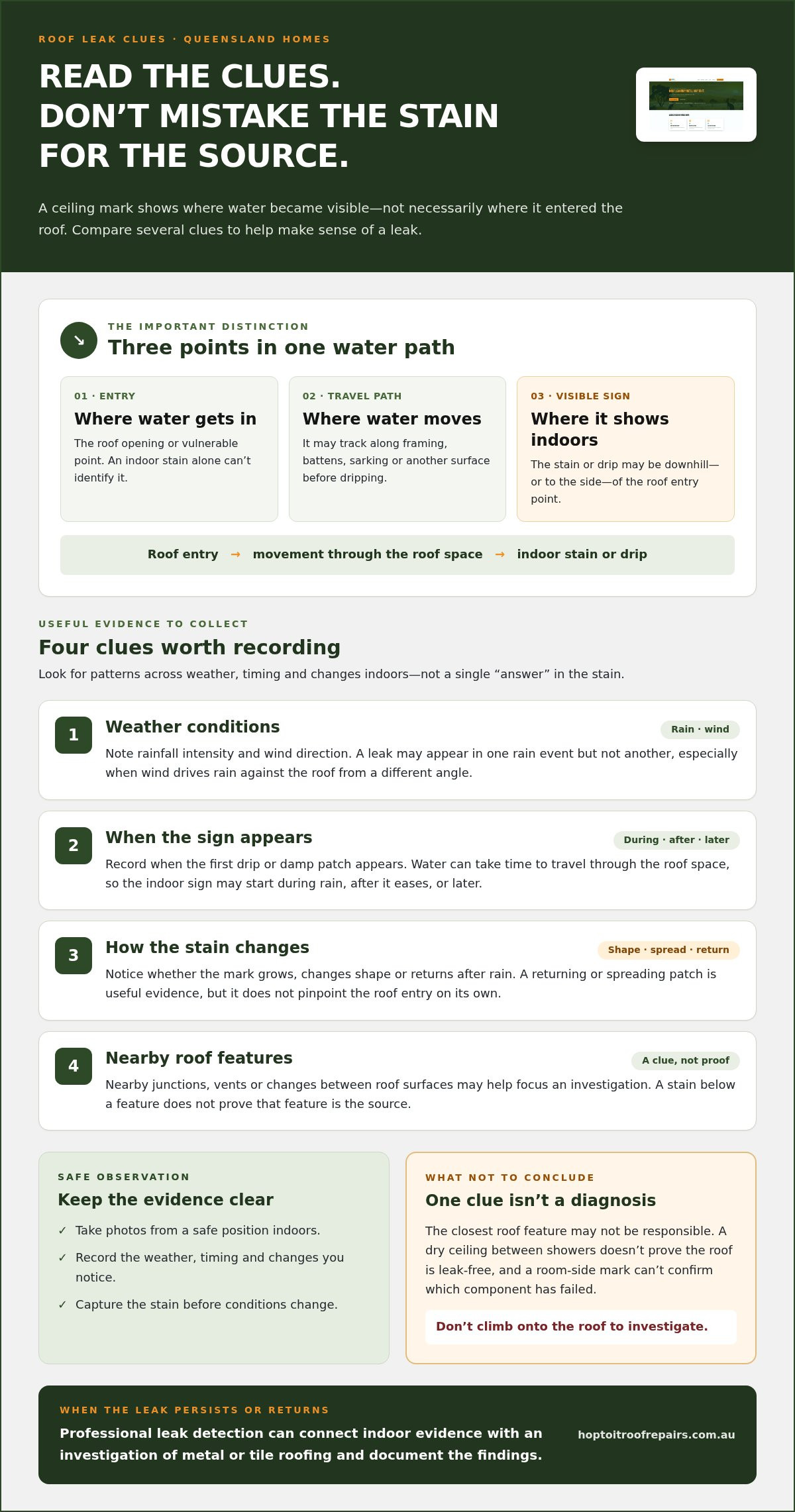
Clues are most useful when you compare them instead of treating one mark as a diagnosis. Note when moisture appears, how the stain changes and what’s nearby. Together, these details can help focus an investigation. On their own, they can’t confirm a roof defect or identify the exact entry point.
What you observe: The mark appears during heavy rain.
What it may suggest: Rainfall conditions could be relevant to the leak.
What remains unproven: The entry point and failed component.
What you observe: A stain grows or changes shape.
What it may suggest: Moisture may be affecting a wider area or following a path.
What remains unproven: Whether the water came from the roof or another source.
What you observe: The mark is near a roof feature or below a gutter or downpipe.
What it may suggest: These areas may be useful context for an inspection.
What remains unproven: That the nearby feature is leaking. Position alone doesn’t establish the cause.
What you observe: Moisture appears in a room away from the likely roof entry.
What it may suggest: Water could have travelled through the roof space.
What remains unproven: The route it took or where it entered.
What timing, location and weather patterns may reveal
Record whether the mark appears during rain, after it stops or in dry weather. If you can readily observe wind direction, note it, but don’t treat it as a diagnosis. Check whether the same pattern returns in similar conditions. Repeated timing and location can help narrow an inspection, while a single event may offer only a partial picture.
Gutters and downpipes are part of the roof’s drainage context. If you can see from the ground that water is overflowing or a downpipe is discharging unusually, record that observation. It may be relevant, but it doesn’t prove the gutter or downpipe is the source of an indoor stain.
Roof leak or another source of moisture?
Rain isn’t the only possible cause of indoor dampness. A plumbing leak or condensation can also leave moisture or staining. Timing and location help distinguish possibilities: a mark that changes with rainfall provides a clue, while moisture that appears independently of rain may point elsewhere. Neither pattern confirms the cause. Identifying the source first helps direct the right investigation and repair.
For broader household leak awareness, EPA WaterSense offers general guidance on finding leaks. A roof assessment is still needed to establish whether water is entering through the roof. With a water tracking roof leak, keep your notes factual: describe what you saw, when it happened and how it changed. Treat each clue as a lead to investigate, not proof of a fault.
What to do if you notice water tracking from the roof
Keep the response simple: make the area safe, record what you can observe, then arrange an assessment if the leak persists or returns. Don’t try to trace a water tracking roof leak by climbing onto the roof or entering a ceiling space. Wet surfaces, hidden damage and electrical hazards can make those areas unsafe.
- Protect people and belongings. Keep people clear of dripping water and move furniture or valuables if you can do so safely. Don’t touch wet electrical fittings or switches. If there’s an immediate safety risk, keep clear and seek appropriate urgent help.
- Record the clues from indoors. Take photos of the stain and any dripping from a stable, safe position. Note when water appeared, whether it was raining and how the mark changes. If you can readily observe wind direction, add it to your notes, but don’t go outside into unsafe conditions to check.
- Arrange an assessment. If the mark recurs, spreads or has no clear explanation, have the roof investigated. A stain alone can’t identify the entry point, and guessing at a repair may leave the source unresolved.
Document the leak while keeping clear of hazards
Capture the wider area as well as a closer view, so the location and shape of the mark are clear. Keep a short log with the date, approximate time, rainfall conditions and whether the water appeared during or after rain. Avoid touching sagging or wet ceiling materials, and don’t use a ladder to inspect the roof space. Clear records help an assessor compare what happened indoors with conditions at the roof.
For a more detailed overview of how an assessment can trace the source rather than rely on the ceiling mark, see this professional roof leak detection guide.
When a roof leak needs professional investigation
Arrange an investigation if water returns after rain, the damp area grows or you can’t explain the moisture. A professional assessment can follow the evidence beyond the visible mark and help establish whether the roof is the source. That distinction matters: repairing the spot directly above a stain may not address the actual entry point.
If you’ve noticed overflowing gutters or unusual water flow near a downpipe, record that too. It’s useful drainage context, not proof that the gutter caused the indoor leak. These gutter repair tips explain why drainage clues may matter. For a documented investigation of a metal or tile roof leak, arrange professional roof leak detection with Hop To It Roof Repairs.
Professional water tracking roof leak detection in Brisbane and the Gold Coast
A ceiling mark is only one part of the evidence. Professional leak detection looks beyond the indoor symptom to investigate where water may be entering the roof and how the clues fit together. Hop To It Roof Repairs investigates leaks in metal and tile roofs across Brisbane, the Gold Coast, Redland Bay, Moreton Bay and Ipswich.
Your notes can give the investigation useful context. Explain when the stain appears, whether it follows particular rain or wind conditions, and whether it has changed or returned. Photos taken safely indoors can also show the mark’s position and development. These observations don’t prove the source, but they help separate what you’ve seen from what still needs to be established on the roof.
From water-tracking clues to a clear repair scope
With a water tracking roof leak, the aim is to connect the indoor signs with the roof investigation, rather than assume the stain marks the entry point. Hop To It Roof Repairs provides a detailed written report for every job, recording the findings for you. The report helps make clear what the investigation identified and what repair work is proposed.
Before repair work proceeds, you receive a fixed-price quote. This gives you a defined repair scope to consider based on the findings, rather than a guess based only on the ceiling mark. Repair work is backed by a workmanship warranty.
A clear scope matters because treating the visible stain without addressing the identified source may leave the leak unresolved. The written findings and quote give you a practical basis for understanding the work before it begins.
Local roof leak help across South East Queensland
Hop To It Roof Repairs is a QBCC-licensed roof plumbing specialist serving Brisbane, the Gold Coast, Redland Bay, Moreton Bay and Ipswich. The team detects and repairs leaks in both metal and tile roofs. Whether the indoor clue is a recurring damp patch or a drip that appears only in certain rain, an investigation can follow the evidence beyond the room where it shows up.
Keep your observations ready, but leave roof access and leak tracing to a specialist. You’ll receive documented findings and a fixed-price quote for the repair work, giving you a clear next step based on the investigation. Arrange roof leak detection with Hop To It Roof Repairs.
Move from uncertainty to a clear next step
A fading stain can make a leak feel less urgent, but it doesn’t explain what happened inside the roof. Keep your observations and photos even if the mark dries out. If moisture returns, that record can help turn a water tracking roof leak from a frustrating mystery into a problem that can be properly investigated.
There’s no need to identify the entry point yourself or attempt a roof repair based on the ceiling mark. Focus on keeping people and belongings safe, then leave the roof assessment to a specialist. Understanding the source first helps ensure the next decision is based on evidence, not guesswork.
Hop To It Roof Repairs is a QBCC-licensed roof plumbing specialist serving South East Queensland. Each job includes a detailed written report and fixed-price quote, and repair work is backed by a workmanship warranty. Take the next step towards clarity: arrange professional roof leak detection. With the source investigated and the findings documented, you can make an informed decision about what happens next.
Frequently Asked Questions
Can a roof leak travel sideways before it reaches the ceiling?
Yes. Water can move sideways along roof surfaces or framing before it drips through a ceiling, so the stain may be some distance from the entry point. In a water tracking roof leak, the route depends on the roof’s construction and the conditions bringing water in. Treat the mark as a clue, not a diagnosis. If it returns or has no clear cause, arrange a roof assessment.
Does a ceiling stain always mean the roof is leaking?
No. Rainwater entering through the roof is one possible cause, but plumbing leaks and condensation can also leave indoor moisture. The stain’s position alone can’t tell you which source is responsible. Note whether it appears after rain, after using plumbing nearby or during a humid period, and record any changes. If the cause remains unclear or the dampness returns, arrange an appropriate assessment rather than assuming it’s a roof fault.
Should I go into the roof cavity to find a leak?
Don’t enter a cavity that’s unsafe, poorly lit, hot or affected by water near electrical equipment. Hazards can be difficult to see from below, and ceiling framing isn’t a safe walking surface. Don’t move insulation or reach towards wiring to follow a damp trail. Instead, record what’s visible from a stable indoor position. If water is near electrical fittings, keep clear and seek appropriate urgent assistance.
Why does my roof leak only when the rain blows in a certain direction?
Wind-driven rain can strike roof surfaces, joints or penetrations differently from steady rain falling more vertically. That may allow water into an area that stays dry under other conditions. The pattern is useful to report, but it doesn’t identify the faulty component by itself. Note which way the wind was blowing if you can tell safely, along with when the leak began, and share those details during an investigation.
Can blocked gutters cause water to appear inside the house?
Yes, drainage problems can contribute to water overflowing or entering around a building, but an indoor stain doesn’t prove a blocked gutter is to blame. Consider what you can safely see from ground level, such as water spilling over an edge during rain. Don’t use a ladder to inspect it. If water keeps appearing or the affected area grows, have the roof and drainage context investigated together.
How soon should I arrange an inspection after finding a roof leak?
Arrange an assessment promptly if water is recurring, spreading or unexplained. While you organise it, move belongings away from the affected area if it’s safe, and keep a note of when the moisture appears. If there’s an immediate hazard, such as water near an electrical fitting, stay clear and seek appropriate urgent assistance first. Roof leak detection is available for homes in Brisbane, the Gold Coast, Redland Bay, Moreton Bay and Ipswich.