Finding a Roof Leak on a Flat Roof: A Safe, Step-by-Step Guide
13 October 2026 · 16 min read

What if the ceiling stain is nowhere near the hole in your roof? When finding a roof leak on a flat roof, treat the indoor mark as a clue, not a map of where water entered. Rain can travel along roof layers and framing before appearing inside, so guessing from the stain or climbing onto the roof can create more risk without revealing the source.
If you’re unsure whether ponding water or a blocked outlet points to a leak, start with what you can safely see indoors and from ground level. This guide explains how to record useful clues, understand why water can appear far from its entry point, and avoid disturbing the roof surface.
Follow the steps to compare possible areas, including drainage, seams and roof penetrations. If the signs don’t reveal the entry point, Hop To It Roof Repairs provides professional roof leak detection and repairs, with documented findings to guide the next step.
Key Takeaways
- Use accessible indoor areas and ground-level views to gather clues without walking on or disturbing the roof.
- Compare signs around outlets, overflows, seams and roof penetrations to guide further investigation, not to make a diagnosis.
- When finding a roof leak on a flat roof, remember water may travel through roof layers before appearing indoors.
- Recurring leaks, several damp areas or water entering after rain are reasons to arrange professional detection.
- Hop To It Roof Repairs provides a detailed written report, a fixed-price quote and a workmanship warranty for every job.
Finding a roof leak on a flat roof starts with safe clues
A flat roof isn’t perfectly level. Its low slope is designed to direct rainwater towards outlets and drainage points. The fall can be difficult to see from the ground, but it affects how water moves: rain may collect or travel across the roof before getting inside. For an overview of flat-roof design, construction and common issues, see Flat Roofs: An Overview.
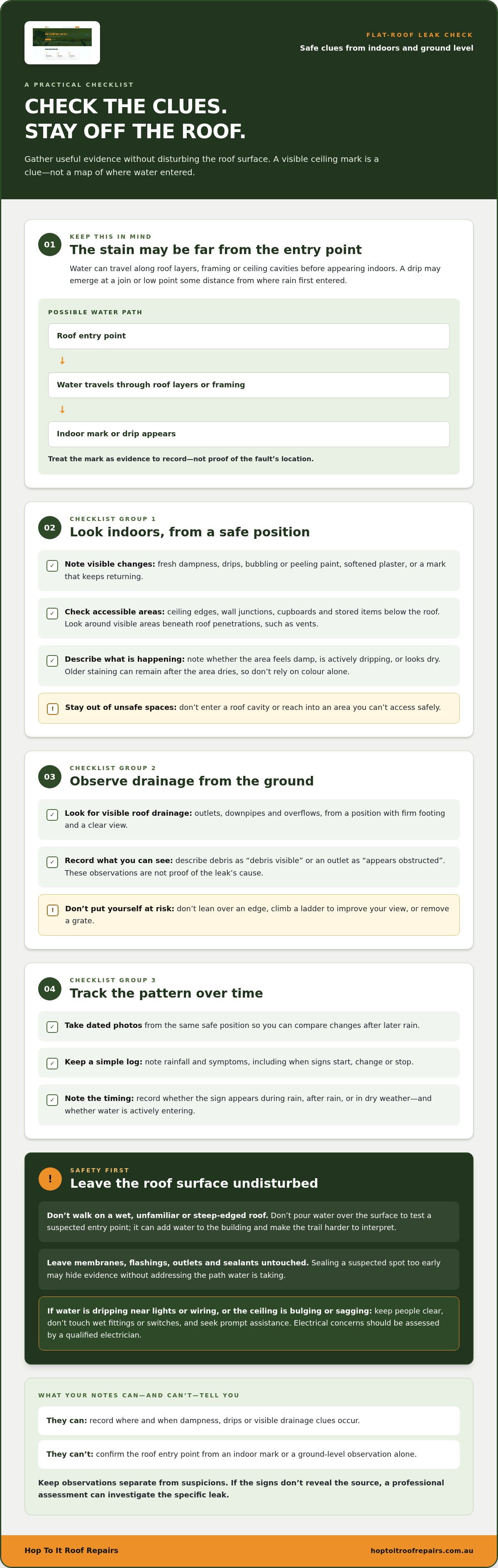
Start indoors. Fresh dampness, bubbling or peeling paint, a drip, or a mark that keeps returning can all point to water entry. None proves the roof has failed directly above that spot. In Queensland, heavy rain and storms can make changes more apparent. Observe and record them from a safe place; don’t climb onto a wet roof to investigate.
Note what you see, where it appears and when it changes. Take photos from the same position so you can compare the mark after later rain. If water is dripping near a light fitting or the ceiling is bulging, keep clear of the area and seek prompt assistance.
- Look for changes to ceiling paint, plaster and wall junctions.
- Check whether stored items or belongings have become damp.
- Record whether the sign appeared during rain, after it, or in dry weather.
What does a flat-roof leak look like inside?
Fresh dampness may feel wet to the touch, while bubbling paint or softened plaster can indicate moisture beneath the surface. Check corners where walls meet ceilings, as well as cupboards or stored items below the roof. Note whether a mark grows or drips during rain. Older staining can remain visible after the area dries, so record whether it feels damp or is actively dripping instead of relying on colour alone.
Why can water appear away from the roof entry?
Water can travel along roof layers, framing or ceiling cavities before reaching a visible surface. A drip may emerge at a join or low point some distance from where rain first entered. Visible ceiling damage does not necessarily mark the roof entry point. Treat the stain as evidence to document, not a map of the fault. Tracing a leak from indoors alone may not reveal its source.
When finding a roof leak on a flat roof, start by building a clear record of what changes and when. Keep your observations specific, and leave the roof surface, flashings, outlets and sealants untouched. These safe clues can guide further investigation without turning a suspected leak into a hazardous roof-access attempt.
How to find a roof leak on a flat roof without climbing onto it
You can gather useful evidence without stepping onto the roof. A cautious check won’t confirm the entry point, but it can give a roof leak detection specialist a clearer picture of what’s happening and when.
- Note the symptoms. Record where you see dampness, drips or changes to paint and plaster. Note whether water is actively entering or the mark appears dry.
- Check accessible indoor areas. From a safe position, look around ceiling edges, wall junctions and visible areas beneath roof penetrations, such as vents. Don’t enter a roof cavity or reach into an unsafe space.
- Observe from the ground. Look for visible outlets, downpipes or overflows. If you can see debris or what appears to be a drainage obstruction, record it without treating it as proof of the leak’s cause.
- Document the pattern. Take dated photos from the same safe position and keep a simple log of rainfall and symptoms. Note when signs start, change or stop.
This sequence separates what you’ve observed from what you suspect. Roofing construction can include concealed layers and components, so a surface clue may not show the full path of water. The National Roofing Contractors Association provides roofing industry resources, while a professional assessment can investigate the specific leak.
Which clues can you check from inside and ground level?
Look for dampness near ceiling edges, wall junctions and below visible roof penetrations or internal drainage routes. Outside, choose a position with firm footing and a clear view of downpipes and outlets. Don’t lean over an edge, climb a ladder to improve your view or remove a grate. Describe drainage as “debris visible” or “outlet appears obstructed”, not as a confirmed cause.
What should you avoid during a DIY leak check?
Don’t walk on a wet, unfamiliar or steep-edged roof, even if it looks sturdy. Never pour water across the surface to test a suspected entry point. This can add water to the building and make the trail harder to interpret. Leave membranes, flashings, outlets and sealants undisturbed. Sealing a suspected spot too early may hide evidence without addressing the path water is taking.
Take extra care if water is actively dripping near lights or wiring, or if the ceiling is sagging. Keep people clear of the area and don’t touch wet fittings or switches. Arrange appropriate professional help; electrical concerns should be assessed by a qualified electrician.
Dated photos and clear notes make it easier to explain the pattern, especially if symptoms appear only during certain rain events. If your observations don’t reveal the source, professional roof leak detection from Hop To It Roof Repairs can investigate the evidence rather than rely on a guess from indoors.
Flat-roof leak sources: compare drainage, seams and penetrations
Several parts of a flat roof may warrant investigation when water gets inside. Drainage outlets and overflows manage rainwater; seams join sections of roofing; penetrations are points where pipes, vents or other services pass through the roof. These are possible inspection areas, not diagnoses. As Flat Roof Construction and Weak Points explains, roof construction varies, so the relevant details depend on the roof system.
Use the table to organise what you’ve noticed. A clue can help focus a professional inspection, but it can’t confirm a defect by itself.
| What you observe | Possible area for professional inspection | What the clue does not prove |
|---|---|---|
| Water appears after heavy rain; a visible outlet or downpipe seems obstructed | Drainage outlet, overflow or connected downpipe | That a blockage is the only issue or the source of water entry |
| Water remains in a low-looking area of the roof, if visible from the ground | Drainage and the surrounding roof surface | That ponding alone has caused a leak |
| A leak recurs after rain, with no obvious drainage clue | Seams or joints between roof sections | That a seam has failed |
| Dampness appears below or near a vent, pipe or other roof fitting | Flashing and junctions around the penetration | That the entry point is directly above the damp patch |
| Water appears near an outer wall or roof edge | Roof edges, junctions and nearby drainage details | That the edge itself is defective |
A visible symptom is a reason to investigate, not confirmation of a roof defect. When finding a roof leak on a flat roof, keep observations separate from conclusions. Water may travel through concealed parts of the roof before becoming visible indoors, and more than one area may need checking.
Could drainage outlets or ponding be linked to a leak?
Leaves and other debris can restrict an outlet or downpipe, leaving rainwater on the roof for longer. From the ground, note visible debris, water at an overflow, or a downpipe that appears blocked. Don’t climb up to clear an outlet or assume that clearing it will repair an existing leak. Ponding is an observation that can guide an inspection, not proof of the entry point.
Could seams, edges or roof penetrations be involved?
Roofers may examine joints between sections, edges, and flashing around pipes, vents or other fittings. Wear or movement can affect how these junctions meet, but a ground-level photo can’t establish what is happening beneath the surface. Record where dampness appears and which fittings or edges are nearby. Leave the roof system and its materials undisturbed until they can be assessed.
These comparisons help narrow the investigation without turning a likely area into a guessed diagnosis. A professional can assess the roof’s construction alongside the visible evidence, then identify which areas need closer attention.
When flat-roof leak clues call for professional detection
Some signs are difficult to interpret from inside or at ground level. Arrange a professional assessment if a leak returns after rain, water appears in more than one area, or dampness keeps spreading during dry weather. These patterns deserve attention, but they don’t identify a single cause. Concealed roof layers and framing can let water travel before it reaches a ceiling, so visual checks may not reveal where it entered.
Finding a roof leak on a flat roof is not always a matter of spotting an obvious hole. An inspection considers the roof and the evidence together, rather than treating a ceiling mark as a diagnosis. For an overview of how specialists trace the source, read about professional roof leak detection in Brisbane.
Queensland storms can bring heavy rain and hazardous roof conditions. Don’t climb up to inspect or cover a suspected leak during or after a storm. Keep people away from affected areas, especially if water is near electrical fittings or the ceiling is sagging, and arrange appropriate professional help.
What information helps a roof leak inspection?
A clear record helps explain how the problem behaves. Prepare dated photos of internal marks taken from safe positions, and note the rainfall timing, affected rooms and whether the leak has returned. Include previous repair attempts, if any. You can also record visible debris near an outlet or water at an overflow, but describe these as observations, not confirmed causes. This gives the inspection useful context without jumping to conclusions.
When should storm-related water entry be made safe?
Prioritise people and belongings, and keep clear of wet ceilings, sagging plaster and water near lights or wiring. Don’t touch wet electrical fittings or attempt roof access in storm conditions. Hop To It Roof Repairs provides emergency temporary make-safe work to help protect a property while permanent repairs are planned. Make-safe work is not a substitute for locating and addressing the underlying fault.
If water is actively entering, first keep people clear and record what you can safely observe. Then arrange professional roof leak detection from Hop To It Roof Repairs to investigate the evidence and identify the next step. Clear findings help guide repair planning without relying on a guess from the stain or rushing onto a wet roof.
What happens after you arrange flat-roof leak detection?
Professional detection investigates the roof and available evidence instead of guessing from a ceiling stain. Your notes and photos can help explain when water appears, while the inspection helps connect those symptoms with possible roof issues. The aim is to establish findings that guide the next step, rather than recommend a repair before the roof has been assessed.
For homeowners, that means a clearer path from suspected leak to informed repair planning. Hop To It Roof Repairs documents findings and sets out proposed work in a fixed-price quote. You can review the report and recommended scope before deciding how to proceed.
How do findings become a clear repair plan?
Hop To It Roof Repairs provides a detailed written report for every job. It records the findings so you can understand how the observed symptoms relate to the areas investigated. If repair work is recommended, a fixed-price quote sets out the proposed scope and price, so you can see what the work involves before it begins. Completed repair work is backed by a workmanship warranty.
This sequence matters because finding a roof leak on a flat roof may involve more than the area where water shows indoors. Documented findings give you a reference for the repair decision, while the quote clarifies the proposed work. Recommendations should follow the inspection, not assumptions about the roof material or a patch chosen before the source is understood.
What can local homeowners do next?
If you’re in Brisbane, the Gold Coast, Redland Bay, Moreton Bay or Ipswich, have your symptom dates and safe observations ready when arranging help. You don’t need to identify the fault yourself. A brief timeline of rain and water entry, plus photos taken from safe positions, can give the inspection useful context.
A written report and clear quote help turn uncertainty into a practical repair decision. Arrange roof leak detection with Hop To It Roof Repairs and share what you’ve observed so the findings can guide the next step.
Turn uncertainty into a clear next step
The next step in finding a roof leak on a flat roof isn’t another guess from indoors. It’s a professional assessment that turns uncertainty into evidence you can use to make a repair decision. Keep your notes handy, but leave roof access and suspected repair points to a specialist.
Hop To It Roof Repairs is a QBCC-licensed roof plumbing specialist in Queensland. Every job includes a detailed written report, followed by a fixed-price quote for the proposed work. Completed repair work is backed by a workmanship warranty, giving you documented findings and clear information to guide your decision.
If you’re ready to move from clues to an investigated next step, arrange professional roof leak detection with Hop To It Roof Repairs. Start with what you’ve noticed and take the next step with confidence.
Frequently Asked Questions
Can I find a flat-roof leak from inside the house?
You can gather clues indoors, but they may not reveal the exact entry point. Check whether a damp mark changes after rain and whether nearby rooms show similar signs. Also consider other sources, such as a leaking pipe or condensation, particularly if the dampness doesn’t seem linked to wet weather. Keep your observations factual and arrange an assessment if the water returns or spreads.
Is ponding water on a flat roof always a leak?
No. Water sitting on a low-slope roof is a sign to observe, not proof that water is entering the building. Note where it collects and whether indoor dampness appears around the same time, but don’t assume the two are directly connected. From a safe position, record visible drainage concerns for an inspection. Don’t climb up to clear an outlet or test the roof yourself.
How do I find a flat-roof leak after heavy rain?
Start indoors once conditions are safe. Look for fresh dampness, active dripping or a new change to a ceiling or wall, then note when it appeared in relation to the rain. Take a dated photo and check whether the same area changes as it dries. Don’t go outside onto a wet roof to search for damage. If water is entering repeatedly, arrange professional detection rather than waiting for another downpour.
Can a flat-roof leak show up far from the entry point?
Yes. Water can move along building materials or concealed spaces before it becomes visible, so a drip may appear some distance from where water entered the roof. For example, a mark near an internal wall doesn’t establish that the roof edge above it is faulty. Record the visible location and any changes over time, but leave the leak path to be traced through a professional assessment.
Should I climb onto my flat roof to check for a leak?
No. A roof can be slippery after rain, and its surface or edges may be unfamiliar or unsafe to access. Walking on it can also disturb roofing components or make damage worse. Don’t pour water over the roof to recreate a leak. Stay at ground level and indoors for your checks. If access or an inspection is needed, arrange professional help rather than taking the risk yourself.
What should I tell a roof leak detection specialist?
Explain when you first noticed the issue, which rooms are affected and whether it has happened more than once. Share dated photos, the timing of rainfall and details of any previous repair attempts. Mention visible signs such as an overflowing downpipe, but describe them as observations rather than causes. If you’re in Brisbane, the Gold Coast, Redland Bay, Moreton Bay or Ipswich, these details can help start a focused assessment.
Does a ceiling stain always mean the flat roof is leaking?
No. A stain may be left by an older leak that has dried, or moisture may come from another source, such as plumbing. Its colour or position alone can’t confirm what caused it. Note whether the area feels damp, changes after rain or returns after drying. If you’re unsure, an inspection can help distinguish a current roof issue from an old mark or another source of moisture.